
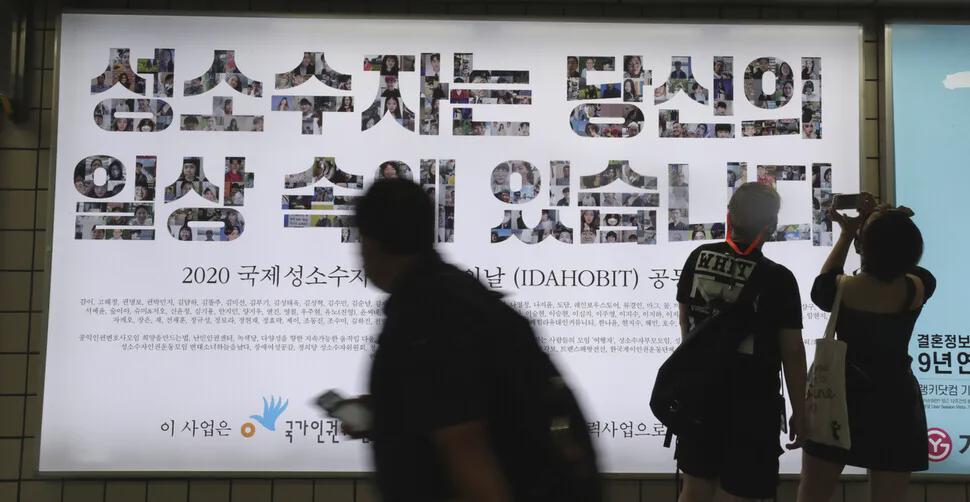
The Ministry of Education has been found to have omitted content related to sexual minorities from a newly created guidebook on responding to hate and discriminatory expressions. Six of the seven experts whom the ministry asked to review the guidebook strongly protested the omission, saying that “the government itself is encouraging discrimination and hatred.” Critics argue that the Lee Jae-myung administration’s reluctance toward enacting a comprehensive anti-discrimination law, particularly regarding issues involving sexual minorities, is reflected directly in the new guidebook.
According to reporting by The Hankyoreh on the 27th, the Ministry of Education developed the guidebook in response to the Paichai High School baseball team’s mockery of the May 18 Democratization Movement and plans to distribute it to schools nationwide in the near future. This is the first time the ministry itself has produced a guidebook specifically addressing hate and discrimination.
In preparing the guidebook, the ministry referred to a draft of the Seoul Metropolitan Office of Education’s Guide to Preventing and Responding to Hate and Discriminatory Expressions, which has not yet been distributed. The Seoul education office had been preparing the guide even before the Paichai High School incident as part of an effort to address the widespread culture of hate in classrooms. However, all content related to sexual minorities that appeared in the Seoul education office’s draft was removed from the ministry’s version.
The new guidebook also represents a retreat from standards used under the Moon Jae-in administration. In 2020, the National Human Rights Commission of Korea and the Council of Governors of Education jointly produced and distributed a booklet titled Is Our School Safe from Hate Speech?, which explicitly identified “sexual orientation” and “gender identity” as criteria for determining hate speech.
Six of the seven experts asked by the Ministry of Education to review the guidebook objected to the changes and withdrew their names from the review panel. Hong Seong-su, a professor of law at Sookmyung Women’s University who withdrew from the panel, said, “When discussing hate speech, foreigners and migrants, people with disabilities, women, and sexual minorities have traditionally been treated as representative target groups. I argued that not even mentioning sexual minorities could be regarded as intentional exclusion or discrimination and therefore had to be corrected, but my recommendation was not accepted.”
Cho Hye-in, an attorney with the public-interest lawyers’ organization Hope and Law, also said, “The ‘social controversy’ or ‘opposing complaints’ surrounding sexual orientation and gender identity are themselves precisely the forms of hatred and discrimination that this guidebook claims it seeks to prevent and address.” She added, “Removing references to sexual minorities runs directly counter to the direction proposed by the guidebook. I expressed concern that this amounted to a discriminatory policy decision under which the central and local governments would tolerate and enable the hatred and discrimination experienced by sexual-minority students, but that concern was ignored.”
A high school teacher in Seoul who also withdrew from the review panel said, “The reality in schools today is that sexual-minority students are mocked through discrimination and hatred, and some attempt suicide. This is not simply a problem among children; it is directly connected to student safety. Schools therefore need clear standards and guidelines that allow them to respond.”
Lee Hye-jung, a professor in the Department of Education at Gyeongin National University of Education, likewise said, “Students very routinely tease one another by saying things such as, ‘You seem gay,’ or ‘Are you gay?’ Explicitly stating that hatred against sexual minorities is prohibited gives teachers a basis for addressing such behavior and can actually help prevent complaints from parents. The Ministry of Education therefore needs to provide clearer standards.”
There are widespread claims that the decision reflects an atmosphere within the government that is conscious of the concerns of Christian groups. Jung Min-seok, head of the youth sexual-minority support center DDing Dong, said, “The president, as well as Democratic Party leader Kim Min-seok, have either expressed reservations about an anti-discrimination law or sent signals to Christian groups telling them not to worry. In that kind of atmosphere, which ministry or cabinet member would be able to voice a different position?”
Asked why sexual minorities had been omitted, a Ministry of Education official said, “The metropolitan and provincial education offices expressed the view that including content related to sexual minorities would make it difficult to distribute the guidebook to schools because of opposing complaints and similar concerns.”
Posted by Freewhale98
1 Comment
1. Summary
Korea’s Ministry of Education sent out guidelines that removes the mentions of LGBTQ+ in anti-discrimination education. Six out of seven experts who involved in writing the original draft protested the removal. There is speculation that President Lee Jae-Myung or Democratic Party Leader Kim Min-Seok influenced the removal.
2. How is this related to the sub
(1) LGBTQ+: Korea’s education ministry is accused of lessening the protection for “sexual minorities” aka LGBTQ+.
3. My opinion
Democratic Party of Korea failed to overcome their own homophobia. Following pic shows Kim Min-Seok, former PM, current DPK leader and devoted Christian who warned about homosexuality spreading through social pressure.
https://preview.redd.it/yfuk05uc64mh1.jpeg?width=1170&format=pjpg&auto=webp&s=ed4b809f3a5f3cf4559c0fb63e34c0bece865824
Gamers are welcomed but gays are not.