
Teachers face more violence as resources fall short for complex classrooms and kids who need support
Bridget Healy was attacked on the eighth day of the school year. The first week had been full of violence.
Ms. Healy was teaching a Grade 4 class at a school in Innisfil, Ont., in the fall of 2023. A safety plan had been put in place for one of the 23 students – a blueprint for how to respond if the student’s behaviour put others at risk.
The student was known to act out, but was not deemed violent enough by administrators to require full-time support. Instead, one educational assistant split her time between Ms. Healy’s classroom and the one next door. “The classroom next door also had a violent student, but he was six foot tall and 200 pounds, and so that’s where the EA spent most of her time,” Ms. Healy said.
She had a walkie-talkie to communicate with her colleague if she ever needed help. She had used it every morning: “Every single day since the start of school he would come right up to my face, scratch me, hit me and I would walkie for help and they would come.”
On the eighth day, the student, who was diagnosed with autism spectrum disorder, began hitting Ms. Healy. She called for help and followed the safety plan: Walk away without acknowledging the student. “But he ran faster than the EA could catch him, and he clocked me in the back of the head three times. And the EA had to pull him off me,” Ms. Healy said.
She knew she had suffered a concussion, having experienced similar symptoms after a car accident and after a work injury as a teenager. A doctor soon confirmed her suspicions. It took months before she could return to school.
Ms. Healy’s story is an extreme example of a phenomenon that has become a regular occurrence in classrooms across Canada.
Data from across the country gathered by The Globe and Mail show that acts of violence against elementary and high-school teachers are on the rise. The causes are complicated: overcrowded and increasingly complex classrooms, a lack of funding for support staff such as EAs and social workers, and inadequate screening for behavioural concerns.
Students involved in such incidents are often struggling with mental-health issues or have developmental disabilities such as autism. There are often inadequate resources to support them.
Many teachers are at breaking point. They are urging education ministries and school boards to solve the problem – but not everyone can agree on how.
Statistics from several school boards and governments across the country suggest a troubling rise in violence against teachers.
Incidents range from verbal threats and spitting to kicking, punching, hair-pulling, stabbing with pencils and throwing desks and chairs. Since the return to classrooms after COVID-19 pandemic lockdowns, these acts have become more frequent.
The Toronto District School Board, the largest in the country, recorded 5,138 violent incidents by a student against a staff member in the 2024-25 school year, up from 4,077 incidents in the 2018-19 school year, an increase of 26 per cent.
The total student population at the board dropped slightly over that period as violence increased.
A spokesperson for the board said these numbers need to be taken with a grain of salt. “We take all reports of violence in the workplace very seriously,” Ryan Bird said in a statement.
“These numbers represent incidents that have been reported by staff, but not yet investigated, and cover a wide range of situations which may or may not have resulted in an injury. It’s important to note that some of these incidents include multiple employees reporting the same incident.”
But similar increases have been reported elsewhere. The Peel District School Board, the second largest in Ontario, recorded 7,039 such incidents in compliance with the Ontario Health and Safety Act in 2024-25, up from 3,102 in 2018-19 – a 127-per-cent increase.
Multiple staff members may submit reports relating to the same incident, and so the number of reports may be higher than the number of incidents.
In the last school year, Edmonton Public Schools, the largest public-school division in the Alberta capital, recorded 25,783 incidents of violence against staff members, a 161-per-cent increase over the 9,883 incidents reported in the 2018-19 year.
A spokesperson for the board said several factors help to explain the size of the increase. The total counts the number of times a student engaged in violent behaviour, rather than individual events. (For example, if a student spat at a teacher three times in a row, that would count as three incidents.) The spokesperson said there has also been a greater focus on encouraging staff to report incidents. The total student population has also increased by more than 20 per cent over the same time period.
Not all boards track these data. Other jurisdictions report violent incidents in the aggregate, which can also include altercations between students.
In Nova Scotia, for example, there were 27,117 incidents of violence at schools throughout the province in the 2024-25 school year. That’s 82 per cent more than the 14,864 incidents reported in 2018-19, Department of Education figures show. The data do not break down how many of the incidents consisted of student-on-teacher violence.
There are other data points that suggest the problem is getting worse. Some provinces report a rise in the number of teachers and teacher assistants on short-term and long-term disability leave as a result of violence.
Last year in British Columbia, there were 575 successful short-term and long-term disability claims arising from “an act of violence or force” filed by secondary, elementary and kindergarten teachers and teacher assistants, according to data from WorkSafeBC, the provincial Workers’ Compensation Board. That is an increase of more than 100 per cent since 2018, when there were 285 such claims.
Alberta has witnessed a similar trend. In 2025, there were 230 accepted workers’ compensation claims by elementary and secondary school teacher assistants that were the result of violence, according to data from the Workers’ Compensation Board of Alberta. In 2018, there were only 145 such claims, representing an increase of 59 per cent. The province convened an Aggression and Complexity in Schools Action Team last year that recommended better support and earlier intervention for students with complex needs.
At this point, there is widespread recognition that burnout among teachers and educational staff is a problem – one-third of elementary and high-school teachers reported high levels of burnout in a 2024 study – and that safety is a concern. There is no question that classrooms are increasingly oversubscribed and complex.
These issues were at the centre of Alberta’s teachers’ strike in October of last year, which halted classes for several weeks until teachers were forced back to work by provincial legislation. The concerns are also expected to be at the forefront of Ontario labour negotiations this fall.
Darcy Santor is a clinical psychologist at the University of Ottawa and co-founder of the Violence and Harassment Against Educators project. In a survey of 4,000 education workers across Canada published earlier this year, Dr. Santor found 78 per cent of respondents experienced at least one act, attempt or threat of physical violence, while 26 per cent reported PTSD-like symptoms.
The current level of violence in schools should classify them as hazardous workplaces, the study concluded. Dr. Santor likens schools to construction sites, which often feature a sign saying how many days it has been since the last injury.
“If you did that in any school, elementary or high school, the number on that board would be zero,” he said.
Addressing the problem isn’t straightforward. Teachers, unions and governments aren’t in agreement on how to define the apparent rise in aggression, and even less so on what the solution should be.
Teachers, EAs, academics and others point the finger at increasingly complex classrooms in which students with special needs, mental-health issues and other struggles do not have the supports they need.
This is why some people in education are uncomfortable with using the word violence to describe what is happening. To them, it frames the problem in a way that views students as perpetrators, and therefore the ones to blame. They believe that as a result, punitive policy responses will be favoured over ones that centre students’ well-being.
“The labelling definitely mitigates for certain kinds of solutions. Let’s put it that way. You call it violence. It’s like, well, great. Then [Ontario Premier Doug] Ford can say, ‘Let’s send in the cops,’” said Kelly Gallagher-Mackay, associate professor and co-ordinator for the law and society program at Wilfrid Laurier University.
“If the question really is why can’t we hire EAs, not how do we cope with violence in schools, we get a different set of answers,” she said.
The debate over terminology has been a long one inside the offices of the Elementary Teachers of Toronto union, which represents about 11,000 workers, president Nigel Barriffe said.
There is a need to spell out what is happening to teachers, he said. Spitting, kicking, punching and scratching are all acts of violence, and avoiding that word risks obfuscating what is going on in classrooms across the country.
Brian Altay, who heads the union’s health and safety department, said that in many ways, violence is an unavoidable term.
The provincial Occupational Health and Safety Act, designed to protect workers, defines workplace violence consistent with what teachers are facing, he said. When a teacher is a victim of a violent incident, the form they fill out at school is called an employee’s report of a workplace violent incident.
This past school year, there were 2,661 violent incident reports by union members, up from 1,870 the previous year, Mr. Altay said.
That increase is at least partly attributable to the local encouraging members to submit the reports, which they often have not for a variety of reasons, he said – whether it’s because they are too tired to fill out long forms, see violence as a normal part of their job or worry that reporting incidents might hurt their careers.
“The whole point of reporting this is so that you’re giving the board an opportunity to prevent the situation from happening again,” he said, adding the root causes still need to be addressed. “In the vast majority of cases that we’re seeing, it’s not students that are just naturally born violent, but they’re reacting to their needs not being met.”
In Ontario, the government announced it will put more police officers in schools in an effort to reduce violence. As of this September, every school in the province is mandated to implement a School Resource Officer program wherever a local police force offers one.
Officers walk hallways, respond to crimes, act as a deterrent and form relationships with students, sometimes coaching sports teams and presenting in-class lessons.
Many school boards cancelled their resource officer programs in the aftermath of the killing of George Floyd, who was murdered by a police officer in Minnesota in the spring of 2020. Critics say these programs do not make schools safer and increase anxiety among Black and Indigenous students.
But higher rates of school violence have been prompting calls for police officers to return to schools across much of Canada. Education Minister Paul Calandra has argued the programs will help make schools safer and more secure, as well as cause students to develop greater respect for officers.
Mr. Barriffe said he thinks that’s a mistake.
“Police respond after a crisis. What we’re asking is why the crisis happened in the first place,” he said. “Because educational assistants, child and youth workers, psychologists, social workers – they prevent crises from escalating. And prevention is always better, and I would add cheaper, than intervention.”
Dr. Santor, from the University of Ottawa, said police are likely only needed in rare cases.
“For psychologists, violence is a product of frustration, primarily,” he said. “There are some folks that just want to be violent, and that’s when law enforcement is going to be needed. But in most cases, it’s an inability to manage frustration.”
Many teachers and disability advocates say better supports are needed to keep classrooms calm and supportive, and to manage distress before it boils over.
Some argue classroom violence is on the rise because a shift in recent decades toward inclusive education has put students with behavioural issues in regular classrooms without the resources they need. As more students are moved away from specialized classrooms, frustration and aggression are bound to result, advocates say.
“We need to look at whether this inclusion model is actually working,” said Kate Dudley-Logue, vice-president of community outreach with the Ontario Autism Coalition. “If you’re going to fully include children into mainstream classrooms, the supports, resources and accommodations have to be in place to make that successful.”
A recent survey of families and individuals accessing special education supports found 38 per cent felt their child was not in the right placement, 29 per cent said their child is not getting enough academic support and 26 per cent said their child is not even accessing the curriculum.
The wait-list for a psychoeducational assessment that can help identify the supports a child might need and benefit from at school is currently approximately two years, Ms. Dudley-Logue said. The current wait time for a child to be diagnosed under the Ontario Autism Program is more than five years.
“There’s no such thing as access to early intervention any more,” Ms. Dudley-Logue said. She added the increase in violence has only worsened outcomes for kids with special needs. “We used to talk about whether students with disabilities were able to access curriculum properly. But we are at a point now where that’s really not even the story any more. The story is: Are schools even safe?”
Disability advocates say much more funding is necessary to provide students with the supports they need.
In Ontario, the number of students with special education needs has increased by 7 per cent since 2014, compared with 4-per-cent growth in total student enrolment, according to a report from the province’s Auditor-General released in May. Students with special education needs now represent 16 per cent of all students, the report found. Those include students with autism, dyslexia, anxiety, speech impairments, and intellectual and physical disabilities, among other concerns.
David Mastin, president of the Elementary Teachers’ Federation of Ontario, stressed that it’s important not to conflate students who are accessing special education programs with students who have violent tendencies. But he said there is a connection when it comes to what kind of support students are receiving: “Students that are not having their needs met are students that are likely resorting to violence.”
School boards are already spending hundreds of millions of dollars more than they receive from the province to support students who need assistance. Of Ontario’s 72 school boards, 46 collectively spent $397.9-million more than they received in special education funding in the 2023-24 school year, the Auditor-General’s report found.
The province has increased special education funding to more than $3.85-billion a year, Emma Testani, a spokesperson for Mr. Calandra, said in a statement.
“Our focus remains on student outcomes and on ensuring that investments in special education deliver the results that parents expect and that students need to succeed. We will continue reviewing special education and the various models used across the province, while listening to educators, families and school boards to ensure students are getting the support they need in the classroom,” she said.
In B.C., enrolment in schools has risen 11.6 per cent since the 2015-16 school year, while the number of students with inclusive education designations rose 46 per cent and the number of students with autism designations rose 192 per cent, said Anna Geeroms, chair of BCEdAccess, a non-profit organization that advocates for equitable access to education for students with disabilities and complex needs.
This past school year, the provincial government increased operating grants for school boards to address the needs of students with disabilities or diverse abilities by 8.9 per cent. Despite the increase, there simply is not enough money being invested to support students with special needs, Ms. Geeroms said.
“We know that there’s not enough EAs in the classroom. We know there’s not enough school psychologists. We know there’s not enough counsellors,” she said. “When disabled children receive insufficient support or accommodation, they’re more likely to become distressed.”
For many educators, the situation has become untenable.
A survey of 5,000 teachers from across the country released by the Canadian Teachers’ Federation last year found 45 per cent said they had considered leaving the profession in the past year. Two key factors: the safety of their classrooms and the size of their classes.
“It’s almost like it’s expected as part of the job,” one long-time special education teacher with the TDSB said. The Globe is not naming her because she did not have permission from the board to speak to the media.
“We have Kevlar hand protectors. We have Kevlar shin guards. We have Kevlar jackets that we wear,” she said. “I have filled out hundreds of violent incident reports a year.”
She said her jaw has been fractured twice on the job. “Once, I was sucker punched – and then a year later, I was headbutted really bad by a student,” she said.
When she began her career 25 years ago, her classes would be capped at six or seven students with special needs. She had an EA in her room. Now, the cap is 10 students and she has to share an EA with several other classrooms, she said.
As resources dwindle, pressure is mounting, the teacher said. “There’s just a lot of stress and strain that’s starting to show. Families are under more economic constraints. Services are harder to find. There are longer wait-lists, so the needs are just kind of more complicated in our classes.”
When violence happens in a classroom, it doesn’t occur in isolation, said Peter Day, president of the Nova Scotia Teachers Union.
Every other student in the classroom is affected, not just by the learning loss that can occur when a classroom needs to be evacuated after an incident, but from the trauma of the event itself, he said. “We have students who suffer from PTSD because of seeing repeated violence occurring in their classroom.”
Ontario’s major education unions have begun bargaining new collective agreements with the province, and classroom violence will be a top issue, said Mr. Mastin of the Elementary Teachers’ Federation.
That will likely mean pushing for not only smaller class sizes, but other ways of addressing classroom complexity. Class size is a much less complicating factor for teachers than class composition. A class of 26 students who do not have special needs is much different than one in which eight of those students require individualized supports.
During last fall’s teachers strike, the Alberta Teachers’ Association pushed for but failed to get student-teacher ratios that factored in classroom complexity. “For instance, if you had five students in your class that had special needs or required extra support, then that’s factored in to the number of kids who are in your classroom,” said Jason Schilling, president of the association.
This fall’s Ontario negotiations will focus on advocating for better ways to address classroom complexity, including seeking commitments from the government that it will fund more counsellors, psychologists, nurses and other staff to support students who are struggling.
“Our schools need to be a model of what society can do to take care of everyone, and we just don’t do that right now,” Mr. Mastin said.
Joe Tigani, president of the Ontario School Board Council of Unions, said much more funding for support staff is needed to fix what he calls the crisis of violence in the province’s schools. Adding police officers is not the answer, he stressed.
“We need more caring, trained people that are specialists in education in every classification who know the students, who recognize the warning signs and can step in before that becomes a violent incident. And it’s not someone in a uniform,” he said.
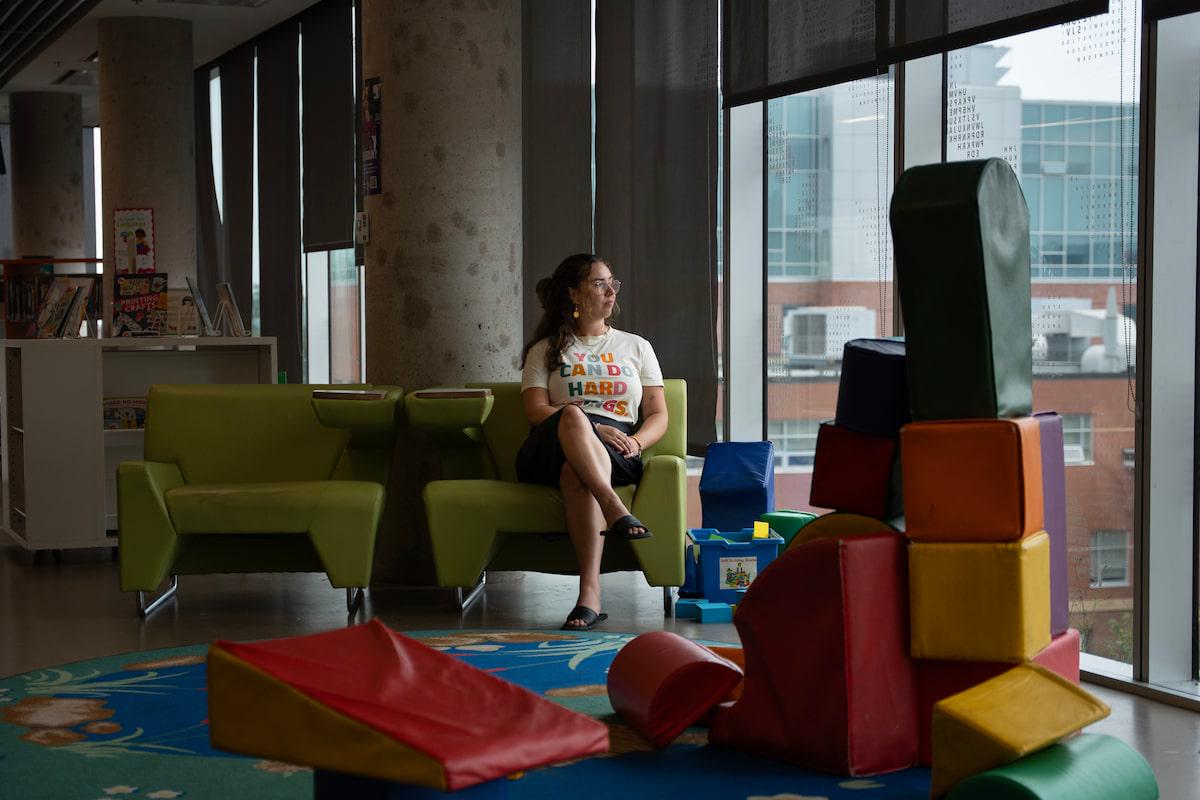
As she slowly recovered from the concussion she suffered at the hands of a student, Ms. Healy could not work for several months, relying on a Workplace Safety and Insurance Board claim to pay her bills.
She returned to the classroom in January, 2024, working two days a week at a smaller school near her home. “I couldn’t drive, and I couldn’t be in a classroom by myself,” she said.
When she was finally able to work full-time, she transferred to another school to teach kindergarten. But even with younger students, Ms. Healy still experienced violence on a regular basis.
Her class of 26 students included 13 who she said were likely neurodivergent and needed extra support.
The school board had denied a request for a dedicated EA to help one of the students, Ms. Healy said. One day in June of 2025, she said, that student destroyed the classroom, throwing its small chairs and desks and using everything they could grab as a projectile.
Violence has been a consistent theme throughout her career so far, Ms. Healy said. She believes smaller class sizes are the first step to solving the problem.
“If there weren’t so many students in my classrooms, then so many of these problems could be avoided,” she said.
The punching incident still haunts her, although she said it never made her question whether or not she wants to continue to be a teacher.
“But it certainly made me question how long I’m going to be able to survive in this system.”
Posted by IHateTrains123