
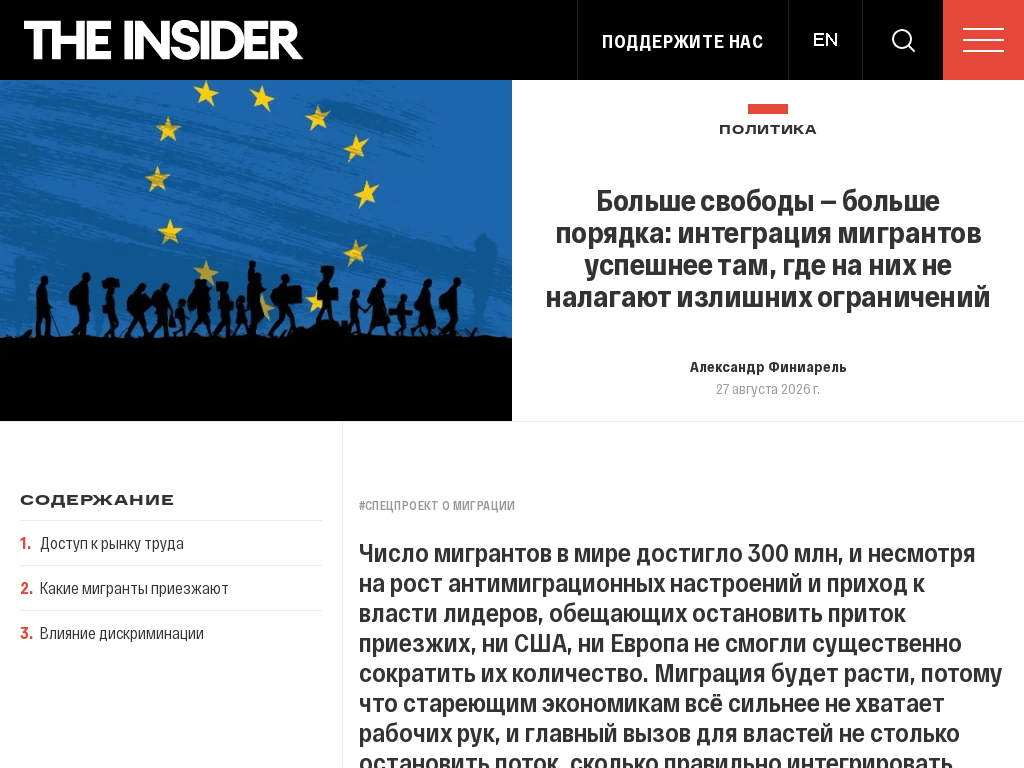
The global migrant population has reached 300 million; despite rising anti-immigrant sentiment and the ascent of leaders promising to halt the influx, neither the United States nor Europe has managed to significantly reduce their numbers. Migration is set to increase as aging economies face a growing labor shortage, and the primary challenge for authorities is not so much halting the flow as effectively integrating migrants to avoid social conflict and reap economic benefits. Global experience in this area varies, but numerous studies show that migration policies have been more successful in countries where migrants enjoyed equal access to the labor market and could participate in civic life. Higher employment rates among migrants and fewer bureaucratic barriers correlate with lower levels of the negative factors for which migration is often criticized—namely, crime and a lack of integration into local society.
The success of migrant integration depends not only on the scale of migration but also on how countries manage the process. In recent decades, nearly all developed nations have been grappling with an acute demographic crisis driven by aging populations. This factor, combined with globalization, has led to an increased influx of migrants into these countries. According to UN data, the global migrant population doubled between 1990 and 2024, reaching nearly 300 million people, although the proportional increase was far more modest—rising from 2.9% to 3.7% of the world's population.
This increase has triggered a widespread wave of anti-immigration sentiment. However, even politicians who rise to power through anti-immigration rhetoric usually fail to stem the influx of migrants.
Thus, Donald Trump only slightly reduced the number of legal immigrants arriving in the United States during his first term, primarily by reducing the admission of refugees under the UN resettlement program.
During the Italian government's tenure under Giorgia Meloni, who also came to power on a wave of anti-immigration sentiment, the number of migrants arriving in the country has only increased . The country even remains the leader in the number of illegal immigrants passing through.
Brexit, which occurred amid British discontent over immigration, led to Europeans leaving the country, but many more migrants from non-European countries arrived in their place.
Russian authorities, by whipping up anti-immigration hysteria, are simply trying to replace immigrants from neighboring countries with people from further afield.
This is happening because migration has an objective incentive: a growing demand for labor. As long as this demand persists, migration will also grow. According to forecasts from the International Organization for Migration , the number of migrants worldwide will exceed 400 million by 2050. Therefore, it is essential to understand how best to manage migration and integrate newcomers.
By 2050, the number of migrants in the world will exceed 400 million people.
As with measures designed to restrict entry, attempts to integrate migrants often produce results that are independent of, or even contrary to, the efforts of the authorities.
For example, Sweden is the most migrant-friendly country in the world, with the highest Migrant Integration Policy Index (MIPEX). However, its integration outcomes are significantly worse than in other countries. Migrants in Sweden commit crimes more often than local residents, earn less, pay fewer taxes, their children perform worse in school, and integration efforts only begin to pay off after decades.
Meanwhile, in Spain, where the share of migrants in the population is similar (just over 20%), MIPEX and spending on integration programs are lower. However, the gap between migrants and locals is also lower across all indicators. Furthermore, migration has reduced unemployment and crime rates in the country and increased GDP per capita.
And in Russia, which is extremely inhospitable to newcomers, with its MIPEX index being very low, migrants commit crimes one and a half times less often than locals, given the same employment level.
Research shows that it is not the costs of integration or the severity of migration policy per se that play a key role, but rather three factors: migrants' access to the labor market, the composition of migration flows, and the ability of institutions to prevent discrimination against newcomers.
Access to the labor market
Employment is the primary factor determining the propensity to commit crimes in any population group. Unemployed people are more likely to commit subsistence crimes, which typically include theft,squattingor, for example, prostitution. They are also more likely to become involved in criminal networks, which essentially represent alternative forms of employment.
Even among employed people, peaks in criminal activity occur during periods of unemployment— holidays . However, during these periods, violent crime increases, largely due to the influence of alcohol. However, holidays have a much smaller effect on crime among the unemployed.
Around 60% of migrants worldwide move for work. Since crime rates among migrant workers are typically lower than among the local population, their influx can even reduce the overall per capita crime rate.
Crime rates among migrant workers are generally lower than among the local population.
This largely explains the paradoxically low crime rate among migrants in Russia—the country practically accepts no refugees , and the vast majority of those arriving here are labor migrants. Since 2014 (during Russia's occupation of Crimea and certain areas of the Donetsk and Luhansk regions of Ukraine), a preferential stay regime has been introduced for Ukrainian refugees, allowing them to immediately work, access government services, and remain in the country indefinitely. A simplified citizenship process was also introduced, so they are almost completely invisible in official crime statistics as migrants.
There are numerous examples demonstrating that the ability to work legally significantly improves migrant integration. A comparison of two waves of immigration to Britain is revealing. For example, in the late 1990s and early 2000s, the country was primarily populated by asylum seekers who were not immediately eligible to work, leading to a rise in property crime. Meanwhile, the wave of migration associated with the admission of ten new countries to the EU, which consisted of people who were immediately eligible to work, actually reduced crime slightly.
A similar situation developed in Italy after Bulgaria and Romania joined the EU. Thanks to the automatic legalization of their citizens, the rate of "survival crime" among them fell by half. Moreover, this effect was primarily observed in the industrialized northern regions of the country, while in the south, where migrants were often already informally employed in agriculture, legalization had virtually no impact on crime.
This effect is also clearly visible in the contrast between English-speaking countries (the UK, Canada, the US, Australia, Ireland, and New Zealand) and continental Europe. This is due to the fact that English-speaking countries are geographically remote from the main conflict zones. Refugees have difficulty reaching them: they are primarily resettled under the UNHCR program.
Accordingly, these people have already received approval for their asylum applications and are immediately authorized to work upon arrival. As a result, in all these countries, the proportion of migrants in prison is lower than their proportion in the general population, and their children perform better in tests than children of local residents.
Refugees enter continental Europe directly through land borders or by sea. Therefore, they are not immediately granted the right to work. A report by the European Council on Refugees and Exiles notes that despite numerous European directives declaring work a fundamental human right and requiring refugees to be given access to the labor market as quickly as possible (even during the application process), many countries actually create various barriers.
In some countries, refugees are held for long periods in camps located in regions with high unemployment or are frequently moved between detention centers, preventing them from finding permanent employment. In others, their documents are either delayed, or employers themselves are unclear whether they have the right to hire asylum seekers whose applications have not yet been approved.
In many EU countries, migrants can only work in a limited number of sectors, primarily in low-skilled positions. Furthermore, in many places, a relevant diploma (and a certain level of proficiency in the local language) is required for senior positions, but educational credentials obtained in other countries are not recognized. Therefore, for example, in Italy, low-skilled migrants are employed more often than Italians with similar qualifications (65.0% versus 53.2%), while highly skilled migrants are less likely to be employed (69.0% versus 85.7%).
In Hungary, temporary residence permits are issued for only three months, requiring constant confirmation of refugees' documents at their workplaces, which increases administrative costs for employers. In Greece, only 3% of refugees were able to open bank accounts to receive their salaries. In the Netherlands, out of 26,520 people who applied in 2021, only 590 were allowed to work—the rest faced bureaucratic barriers.
Ireland is one of eight EU countries where migrants from non-EU countries have higher employment rates than the local population. A similar situation exists in Poland and the Czech Republic, which are home to many Ukrainians, who enjoy a simplified work permit process. Portugal has a similar regime for natives of former colonies. Moreover, in almost all of the EU, with the exception of the Netherlands, France, Greece, Latvia, and Finland, the employment rate of migrants from other EU countries is higher than that of local residents.
In the US, migrants traditionally demonstrated lower crime rates, better health, and better school performance than native-born residents, and their economic performance approached (or even surpassed) that of native-born residents by the third generation. Even refugees had employment rates comparable to those of migrant workers.
However, in the 2010s, an influx of asylum seekers from Latin America began crossing the US southern border, primarily from four countries: Honduras, El Salvador, Guatemala, and Venezuela. This influx was largely a result of US interference in these countries' politics during the Cold War, as these interventions led to long-term destabilization. This instability was also exacerbated by the flow of weapons smuggled into Latin America from the US itself.
Because the refugees arrived in the US directly, rather than through the UN resettlement program, they were restricted in their right to work until their asylum applications were approved. Their integration outcomes were correspondingly worse, forcing the government to spend significantly more money on them.
Thus, the work restriction for asylum seekers leads to long-term negative economic effects. Until it is lifted, refugees are forced to live solely at the expense of the state, becoming dependent on benefits. During this period, they fail to integrate into society because they do not participate in its economic life, and their professional skills gradually deteriorate. As a result, their likelihood of finding employment after receiving a work permit decreases by 15%.
Work restrictions for asylum seekers lead to long-term negative economic effects
In Germany, a court ruling reduced the wait time for work permits for refugees. This showed that those who had to wait seven months longer for a permit were 20 percentage points less likely to find employment than those who had received it earlier. This gap was not closed until ten years later. Researchers estimate that the EU lost €37.6 billion in GDP due to the employment restrictions imposed on refugees arriving during the Syrian migrant crisis.
What kind of migrants are coming?
In Sweden, however, refugees can work almost immediately after applying for asylum, albeit only in low-skilled positions. Nevertheless, the country's integration results are among the worst among all developed countries.
The main influence here is the specific migration flows coming to Sweden. For decades, the country has received a huge number of refugees, primarily from culturally distant countries in the Middle East. The three main countries of origin for migrants in Sweden are Syria, Iraq, and Afghanistan. Sweden currently has the highest number of refugees per capita in Europe.
This policy was largely due to the fact that Sweden, despite its empire built around the Baltic Sea, lacked successful overseas colonies. The country developed more as a continental empire, similar to Russia, the Ottoman Empire, or Austria-Hungary. However, the territories dependent on it (Finland, Norway, the Baltic states, parts of Germany) are today almost as developed as the country itself. Their residents have no incentive to move to Sweden, and they themselves face the same demographic problems. Therefore, the Swedish authorities had to find another way to attract young people to correct the demographic imbalance and fill jobs requiring manual labor.
However, refugees are the most difficult category of migrants to integrate. They adapt significantly more slowly than labor migrants and those arriving for family reunification. Research refers to this as the "refugee gap" —the difference in the rate of integration between refugees and other categories of migrants.
Unlike economic migrants, who typically choose a country in advance, prepare for the move, learn the language, and often already have connections, sought-after skills, or a job offer, refugees are forced to leave their homes. They often lose their property, documents, professional connections, and the opportunity to utilize their accumulated human capital.
Refugees are the most difficult category of migrants to integrate
While migrant workers' movements are determined by their skills and the needs of the market they're drawn to, refugees go where they can find asylum. Their integration is further complicated by trauma, prolonged uncertainty about their legal status, restrictions on access to the labor market while their application is being processed, and administrative resettlement in regions with limited economic opportunities and the absence of a diaspora. Finally, cultural differences pose a significant barrier.
In Spain, the flow of humanitarian migration is currently comparable to that in Sweden at its peak (although, due to the country's five times larger population, the percentage is significantly lower). Moreover, 47% of migrants in Spain are from Latin America, who share a common language and culture. They enjoy visa-free entry into Spain, can work immediately, and are eligible for citizenship after just two years in the country. Another 27% are from other European countries. Only 18% come from Africa, and 6% from Asia (particularly the Philippines, where Spain also had colonies).
Due to historical, cultural and linguistic ties, integration into Spanish society is significantly easier for most migrants than for Middle Eastern migrants in Sweden, despite lower government costs.
Russia also has significant cultural and linguistic influence in Central Asia and large diasporas of people from this region, making it easier for migrants from Central Asian countries to integrate into Russian society.
Similarly, the United States has influenced Latin America for centuries and has large Latin American diasporas. Poland and the Czech Republic also demonstrate high rates of migrant integration, as historically, they were primarily immigrants of culturally and linguistically similar Ukrainians who were able to find immediate employment. Therefore, even when a flood of Ukrainian refugees flooded in after the war, they too integrated relatively easily.
However, cultural differences don't explain the entire gap. The quality of human capital countries attract is also important. For example, the United States is geographically remote from the main migration zones, making the mere possibility of reaching them demanding a significant initial investment. Thanks to high salaries, the United States attracts the most successful and educated people. Therefore, diasporas there compare favorably to European ones.
For example, Middle Eastern migrants to the United States are twice as likely to have a bachelor's degree as the average American and earn slightly more. Meanwhile, in Europe, where they arrived primarily as low-skilled guest workers, undocumented immigrants, or refugees, they represent the most problematic groups, with low incomes and high crime rates.
Similarly, Pakistani migrants to the US have higher income and education levels than local residents, while in Britain they represent one of the lowest employment rates in the country. It would seem that Britain is about as far from Pakistan as the US, so the results should be similar. In this case, the colonial past plays a role: Britain itself imported peasants from the former colony en masse in the 1950s and 1960s to work in factories, and these peasants then brought their families with them.
However, a significant part of the employment gap is also explained by the fact that many Pakistani women, due to cultural traditions and discrimination, prefer not to work and instead focus on housework. This factor is relevant for many Muslim diasporas in Europe.
The Impact of Discrimination
Finally, the extent to which a country's institutions are prepared to receive migrants is also important. Even if a country attracts relatively prosperous influxes and provides rapid access to the labor market, this is not enough. What matters is whether institutions allow migrants to compete with local residents on equal terms.
The United States, Canada, Australia, and New Zealand are countries built by migrants. They have accumulated historical experience and strong diasporas that facilitate the assimilation process. European countries, on the other hand, only transformed from countries of emigration to countries of immigration in the 20th century. They are much more ethnically homogeneous, so they have less experience and practically lack the traditional structures for integration.
A meta-analysis of 97 experiments examining hiring discrimination in nine developed countries (the United States, Canada, France, Belgium, the United Kingdom, Germany, the Netherlands, Norway, and Sweden) found that the highest levels of discrimination in the initial screening of resumes of applicants with "migrant" names were observed in France and Sweden, while the lowest were observed in Germany, Norway, and the United States. Moreover, in Sweden and France, the groups that faced the highest levels of discrimination were those that make up a significant portion of the migrant flow: black people and people from the Middle East.
Thus, the weak results of integration policy in Sweden are also explained by informal practices. For example, candidates with foreign names are screened out during the resume review process. Even with a high state commitment to funding social programs, migrants can face significant barriers already during their first job search. And this is just one type of discrimination. The study's authors note that Germany has managed to establish a system that limits bias in hiring, but discrimination remains high when searching for housing.
Stimulating formal integration also has a positive impact on other aspects of integration. The experience of Switzerland, where naturalization applications in several municipalities were decided through referendums, showed that immigrants who won the vote and thus received citizenship earned, on average, $5,000 more per year over the following 15 years than similar immigrants who did not receive enough votes. Moreover, the effect was particularly strong for the most marginalized groups—immigrants from Turkey and the former Yugoslavia, as well as low-wage workers.
Thus, institutions that not only allow migrants into the labour market but also recognise them as equal members of the political community create long-term economic benefits and increase the chances of successful integration.
Translated by Google Translate, mistakes are my own.
Posted by IHateTrains123