
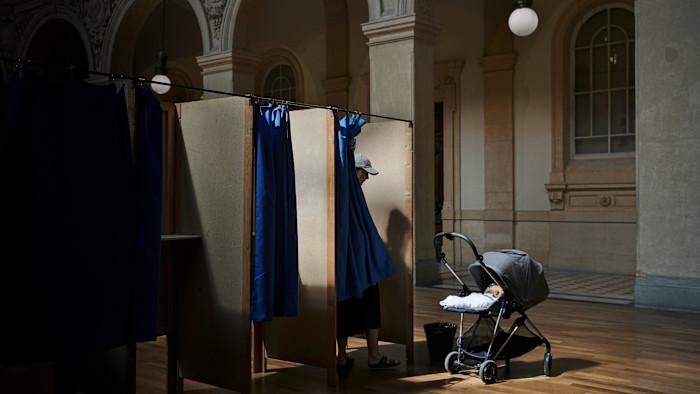
In the space of 12 months, four of the five biggest EU member states will go to the ballot box. The bloc may never be the same
Calling snap parliamentary elections in Spain last week, Prime Minister Pedro Sánchez said Spaniards would soon have to decide whether to stick with his leftwing government or “join the far-right wave”.
The vote on November 29 marks a potential turning point in Spanish politics after eight years of socialist government, with opinion polls suggesting a clear majority for the conservative People’s Party (PP) and its putative partner, the nationalist-populist Vox.
It also marks the beginning of an intense election supercycle the likes of which Europe has not seen in a generation. In the space of 12 months, four of the five biggest EU member states by population will go to the ballot box, as will four smaller ones.
This crammed election season will have an impact on the EU by distracting national governments and making leaders less willing to compromise on fraught issues such as the EU budget, for fear of being accused on the campaign trail of betraying the national interest.
But the supercycle is unusual not just for the timeframe.
“It is pretty extraordinary that these elections are happening at the same time, but also because there are very, very similar dynamics taking place,” says Mark Leonard, director of the European Council on Foreign Relations.
The common trends are striking. There is a broad electoral shift to the right and a growing readiness among centre-right parties to share power with far-right rivals, spelling the end of so-called firewall policies of non-co-operation. The far right has itself radicalised with the arrival of new upstart parties such as National Future in Italy and the Confederation of the Polish Crown (KKP). At the same time, more established ones such as Alternative for Germany (AfD) are becoming more extreme or refusing to moderate the closer they get to power.
Nathalie Tocci, professor at the European campus of Johns Hopkins School of Advanced International Studies in Bologna, says that if the nationalist right held power in Spain, France, Poland and Italy all at once, “I don’t think it’s hyperbolic to say it’s the end of the European Union as we’ve known it.”
Spain will kick off the process (Bulgarians vote for their president on October 25 but the role has limited powers) and Italy could theoretically close it with elections due by December next year, although they are likely to come earlier.
In between, there are presidential and parliamentary elections in France — potentially the most consequential of them all — and legislative elections in Poland. Estonia, Finland, Greece and Slovakia will hold parliamentary votes next year.
One could even include Germany in this cycle. There are no national elections in the country this year. But three regional ones in April could spell the end for Chancellor Friedrich Merz, who appears to be living on borrowed time after his Christian Democratic Union took a hammering in regional elections in eastern Germany last month.
In Spain, the PP has not ruled out co-operating with Vox, including in a coalition, and already governs with it in several regional administrations.
In France, Marine Le Pen, the leader of the far-right Rassemblement National, is the clear frontrunner for the presidential election, while her mainstream opponents are divided and unable to find traction with voters.
Giorgia Meloni, a nationalist populist who has governed Italy largely as a traditional conservative, is well placed to win a second term, but may be forced to bring National Future, led by a pro-Russian former general Roberto Vannacci, into her coalition.
In Poland, the nationalist Law and Justice (PiS), which ran the country from 2015 to 2023, split in two this summer and is haemorrhaging support to two more radical right parties, Konfederacja and the xenophobic and antisemitic Confederation of the Polish Crown (KKP) led by Grzegorz Braun. Still, the four rightwing parties enjoy a combined 47 per cent support, according to a recent opinion poll, and could yet come out on top.
The EU has grappled with nationalist populists at its top table before, such as when then Hungarian prime minister Viktor Orbán defied the EU on various fronts and tried to hold it hostage over support for Ukraine. But the outcome of this election supercycle could be more serious.
“The far right has been a problem for Europe for more than a decade, says Charles Grant, director of the Centre for European Reform. “But the problem is getting worse. It is going to be harder to find a way to work around, as the EU did with Viktor Orbán. It is going to be more systematic and serious.”
‘Our people first’
The last moment of such extensive political alignment was a generation ago.
In November 1998, Gerhard Schröder made his first foreign visit as German chancellor to London, where he bonded with Tony Blair over ideas for a Third Way version of social democracy, melding economic liberalism and social justice.
At that point, the centre-left was in charge in 11 out of the EU’s 15 member states and in coalition in a further two. Some more traditionally minded socialists such as France’s Lionel Jospin chafed at the centrism of Blair and Schröder, but the self-proclaimed modernisers had the political momentum and a powerful ideological ally across the Atlantic in President Bill Clinton.
It was also a time of optimism and progress in Europe. The economy was growing strongly and the EU was moving forward with the imminent launch of the single currency.
Fast forward three decades, and it is the pro-European mainstream that is under siege. The economy is generally weak, living standards are being squeezed, public finances are under severe strain and public policy problems seem intractable.
Europe’s upcoming elections
- October 25, November 1 2026: Bulgaria — presidential elections
- November 29 2026: Spain — parliamentary election
- March 7 2027: Estonia — parliamentary election
- April, may and September 2027: Germany — state elections
- April 18 2027: Finland — parliamentary election
- April 18, may 2 2027: France — presidential elections
- May 30 2027: Germany — state election in Bremen
- Summer 2027: France — parliamentary elections
- By July 25 2027: Greece — parliamentary elections
- September 26 2027: Germany — state election in Niedersachsen
- Autumn 2027: Poland — parliamentary election
- Autumn 2027: Slovakia — parliamentary election
- BY December 2027: Italy — parliamentary election
Now, says Leonard of the ECFR, it is Europe’s nativist parties that feel like they have the tide of history behind them and another US president as trailblazer in Donald Trump.
Why are the political currents in Europe moving in the same direction?
Many of the forces shaping electoral trends in Europe are the same, says Catherine de Vries, professor of political science at IE University in Madrid and an expert on comparative politics.
Long-term demographic and social trends have eroded party loyalty. Party systems have fragmented. Opinion is polarised. France, for example, could end up with a presidential run-off between a far-right and far-left candidate. Perceptions of politics have been made far more negative, in part by social media and the demise of curated news sources.
As a result, Europe is now experiencing unprecedented electoral volatility. More and more people do not vote for the same party in subsequent elections. Voters, especially younger ones, increasingly act as critical consumers, de Vries says. It is a market for votes made for political entrepreneurs with attractively simple messages.
“The radical right has been able to capture, at a time of huge political uncertainty, a very clear direction: we’re going to put ‘our people first’, over migrants, over supranational institutions, over contributions to Ukraine,” she adds.
Meanwhile, de Vries says, mainstream parties are being penalised for their lack of ideological clarity or solutions to public policy problems.
After Merz’s CDU was crushed in state elections in Saxony-Anhalt and Mecklenburg-Vorpommern last month, he conceded that the Christian Democrats “no longer have satisfactory answers to too many questions”.
There are many policy differences between Europe’s nationalist populist and far-right parties, particularly on relations with Russia. These fractures make co-operation difficult. Radical right parties belong to three different groups in the European parliament, for example.
But, says Leonard of the ECFR, they are strikingly similar in several respects.
They share a similar critique of the failures of liberalism and globalisation and they combine it with “crisis entrepreneurship”, reshaping themselves for the crisis of the moment.
Germany’s AfD started off as a movement opposing bailouts for Greece and other southern EU members during the Eurozone debt crisis, became an anti-immigration party during the 2015-16 migrant influx, latched on to anti-vaccination sentiment during the pandemic and now uses the energy price shock to campaign against the green transition and in favour of a rapprochement with Russia.
Such parties also all target those who do not feel the benefits of globalisation, especially less-educated working-class voters.
In addition, the core of their policy prescription is the reassertion of national culture and control, translating into a policy of favouring, for example, French citizens for welfare, jobs or public contracts over foreign nationals, even those with residency.
Finally, they are all digital-native parties, well attuned to an algorithmic information space where provocation gets views.
“Even though they often can’t stand each other and there are really complicated dynamics between them, they are very much learning from each other and have a very similar playbook,” says Leonard. “They’re all looking at what each other is doing, the themes, the ways that they’re campaigning, the ways they use the new media. There is a lot of shared grammar.”
They are also trying to draw inspiration from each other’s success.
Campaigning in a by-election in southern Italy last month, Vannacci said victory for his National Future would be “our Saxony”, a reference to the AfD’s stunning win in regional elections in Saxony-Anhalt in early September. Vannacci’s party failed to take the seat.
A collision course with Brussels
Rising support for the far-right has for several years pulled centre-right parties and governments rightward, especially on immigration and asylum, where they increasingly challenge their countries’ international and European legal obligations.
It has done the same to centre-left parties, particularly in Denmark, Sweden and the UK, which have drastically tightened up their stances on immigration and/or integration.
But now it is nationalist populist parties that are being pulled to the right by their more radical challengers, such as Vannacci, who accused Prime Minister Meloni of betrayal.
“When the radical right is already in government, how do you innovate? By going more extreme?” says de Vries.
In what looks like an attempt to shore up her right flank against Vannacci, Meloni has sharpened her rightwing credentials, picking a fight with Spain’s Socialist government over illegal immigration earlier this summer and banning the burka head-to-toe dress and full-face veil in schools.
In Brussels and other European capitals, Meloni is seen as a model of how a nationalist populist moderates once in power. As prime minister, Meloni has largely toed the line in Brussels, complying with EU fiscal rules, co-operating with the European Commission and working with other EU leaders. She has also been a strong supporter of Ukraine.
“Sometimes the politics plays out in surprising ways,” says Radek Sikorski, Poland’s foreign minister. “We appreciate Prime Minister Meloni, for example, and her stand.”
But the Meloni moderation “model” is not guaranteed to last, given the competition from Vannacci. Furthermore, the EU’s €200bn pandemic recovery fund for Italy, which gave Brussels important leverage over Rome, is coming to an end.
Other far-right parties are defying expectations they will inevitably moderate as they approach power. Indeed, they regard Meloni as a sellout. The AfD looks set to take office in Saxony-Anhalt, yet its regional branch there has been declared “rightwing extremist” by Germany’s domestic security service. Austria’s Freedom party has become even more radical under leader Herbert Kickl and is way ahead at 39 per cent in opinion polls.
Le Pen in France has taken some steps towards moderation. For more than a decade she has tried to “detoxify” the party by rooting out overtly racist elements. More recently, she has set out to bolster the RN’s credibility on the public finances by committing to deficit and debt rules akin to the EU ones the party has hitherto scorned.
In other respects, Le Pen remains a radical set on confrontation with the EU. If elected president, she has pledged to cut €11bn from France’s contribution to the EU budget next year, putting her on a collision course with Brussels and other EU capitals.
She would pull France out of the EU’s common asylum policy and unilaterally withdraw from aspects of the single market, while giving preference to French companies in public contracts. She would also seek to change the French constitution to assert the supremacy of French law over EU law.
The RN several years ago abandoned its policy of leaving the single currency and the EU, but its current policies would amount to a partial exit.
Mujtaba Rahman, managing director for Europe at Eurasia Group, a consultancy, says it is possible to still see a benign outcome for the EU in this election supercycle, where the centre under Prime Minister Donald Tusk holds on in Poland and a re-elected Meloni sticks to her pragmatic course.
A PP/Vox government could even help the EU’s coherence by making Spain more willing to stand up to Chinese trade practices or increase defence spending, he adds, in line with the European mainstream.
“It really hangs on the France question to my mind,” Rahman says.
Even if she failed to win a parliamentary majority, Le Pen would have a direct mandate and a lot of power as president, which Meloni, for example, lacks. She would be a strong voice in the European Council, which brings together the EU’s 27 national leaders, and sets the bloc’s strategic direction and its foreign policy.
Ukraine could be the biggest loser. Le Pen says she would stop bilateral aid to Kyiv apart from for military training, is sceptical about sanctions on Russia and has said she would never agree to Ukrainian membership of the EU, or any other new member.
“I worry most about Ukraine,” says Rahman, citing growing reluctance across the bloc to provide more funding or a speedy accession for Kyiv. “That’s where there just seems to be growing fatigue, growing political fatigue, public opinion fatigue, but also policy fatigue.”
Inside the European Council, a President Le Pen could form a caucus with other Eurosceptic leaders like Czech prime minister Andrej Babiš, Slovenia’s Janez Janša or Bulgarian premier Rumen Radev, who have so far played ball in Brussels but who are lukewarm at best about supporting Ukraine. Le Pen and Meloni might also join forces.
“If they are all in power, then they can afford to be way more radical than if only one of them were in power,” says Tocci of SAIS Europe. “There’s a quality element to this, not just a quantity. Once you get to that critical mass, you can afford to completely lower the mask. You don’t need to pretend [to be moderate] any more.”
Posted by IHateTrains123
1 Comment
In short, the coming wave of elections in Europe, in general, share two noticeable and worrying trends that could possibly reshape the function of the EU. Firstly, is the broad electoral shift to the right and a growing willingness among centre-right parties to share power with their far-right rivals. Secondly is a growing radicalisation within the far-right, as either new far-right parties apply electoral pressure on existing far-right parties or they have been refusing to moderate as they have been getting closer to seizing power.
!ping Europe&Extremism