
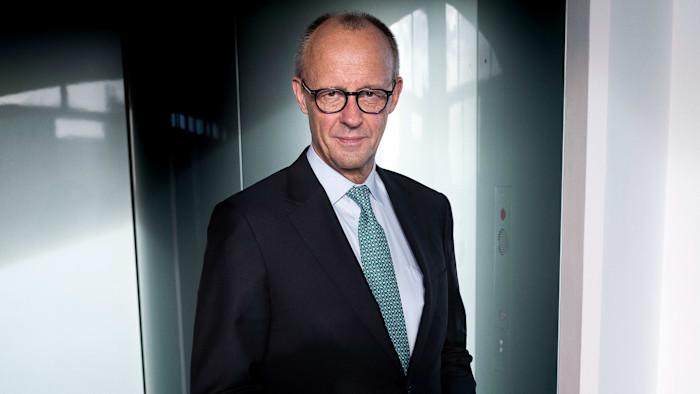
Defiant chancellor tells the FT he is determined to drive through unpopular reforms and equip Europe for an age of upheaval
Germany’s embattled Chancellor Friedrich Merz has vowed to fight on as he races to push through unpopular welfare reform and equip Europe for an age of upheaval.
Speaking to the FT on Wednesday, the German leader ruled out resigning amid growing unrest within his Christian Democratic Union (CDU), which suffered heavy electoral losses in two states last month.
Asked about the pressure on him to step down, Merz said: “I will not.” “This is not the question I’m asking myself,” he added. “The key point is: is this government able to bring fundamental reforms to our social security system? I’m definitely determined to do that.”
Merz’s defiant remarks come as pressure is mounting on the 70-year-old conservative leader to deliver on his promise to revive Germany’s sluggish economy and stem the rise of the far-right Alternative for Germany (AfD).
Since taking office in May last year, Merz has relaxed the country’s debt brake to launch a massive investment package for infrastructure and defence. But his approval ratings have plunged to record lows and his reform drive has been bogged down in disputes with his junior coalition partner, the Social Democrats.
Many within the CDU blame their unpopular party leader for historic electoral setbacks in the former East Germany. In Saxony-Anhalt, the AfD could claim Germany’s first far-right state premiership since the second world war, while in Mecklenburg-Vorpommern, the CDU failed to win seats in a regional parliament for the first time in its 81-year history.
Days before hosting global business leaders in Berlin for the country’s first investment summit, Merz insisted that international investors were far more optimistic about Germany’s economic prospects than its own citizens.
“People are doubting whether we are able to bring these reforms through,” he said. “They are seeing that the economy is still weak. They are seeing that we are losing jobs in our industry.”
But he argued the Invest in Germany conference, which begins on Monday, “will show the German people that the investment climate has really improved in this country”. “I would like to bring more optimism to people because the fundamentals in this country are extremely good.”
Merz hailed his plan to overhaul Germany’s costly pay-as-you-go pension system, including the creation of a Swedish-style pension fund, as a potential “game changer” worth the bruising coalition battles needed to push it through.
“This is something that requires enormous legislative detail because this is so fundamental to the system we’ve had for decades,” he said.
Merz, a former chair of BlackRock’s supervisory board in Germany, said he was pleased to report that “no investor has told us that they will leave Germany because of the AfD” and vowed to bar the anti-immigration, pro-Russia party from power.
He said he was no fan of the term “firewall”, which refers to mainstream parties that reject coalitions with the far right.
But he added: “If there is a firewall, we are the firewall.” “We are the guarantors that we do not co-operate with this party . . . They want to leave the EU, they want to leave Nato, they want to give up support for Ukraine . . . There is no common ground.”
But he admitted he was “not sure” that the AfD’s support had reached its ceiling, with the party polling close to 30 per cent nationwide.
Germany may also find itself dealing with far-right governments in key EU member states, with France, Poland, Italy and Spain all heading to the polls next year.
The election of Marine Le Pen as French president, a staunch eurosceptic who has vowed to weaken the EU from within, would threaten the Franco-German relationship that has been at the heart of the European project.
But Merz said France under a Le Pen presidency would need Europe as much as Germany does: “If that happened, we would try to find ways to co-operate ,” he said.
Merz and Le Pen may agree on one topic: the need to cut down EU rules. “People are really angry about this overwhelming bureaucracy coming from the EU,” he said. “Bureaucracy is now shrinking the potential of the internal market.”
Asked if he was concerned about France’s public finances, Merz warned: “The Eurozone’s indebtedness as a whole has become too high.” To avert a sovereign bond crisis, all Eurozone countries needed to respect EU fiscal rules, “including Germany”, he added.
Merz also stressed the importance of a “strong” and “politically independent” European Central Bank capable of meeting “all the challenges we are seeing on the capital markets, in terms of stability of the euro and in terms of price stability”.
ECB president Christine Lagarde is expected to leave the Frankfurt-based institution before her eight-year term expires in October 2027, giving EU leaders the opportunity to anoint a successor before the French presidential election, people with direct knowledge of the matter have previously told the FT.
If Lagarde were to depart early, “we will be prepared”, Merz said.
The German leader also pledged to dramatically expand the EU’s trade arsenal and deploy it more swiftly and forcefully against foreign economic coercion.
A proposal developed with French President Emmanuel Macron to create a trade weapon allowing the European Commission to quickly restrict access to the single market had been broadly welcomed by other member states ahead of a summit of EU leaders this week, Merz said.
Widely seen as a response to China’s decision to restrict exports of key rare earths and magnets last year, as well as to repeated US threats of a trade war, the instrument would be more than a deterrent, the German leader insisted.
“We will widen the toolbox, we will open the toolbox, we will show the toolbox and we will make use of the toolbox if needed,” he said.
The chancellor praised trade commissioner Maroš Šefčovič for holding “very positive” talks with Beijing on reducing China’s €1bn-a-day trade surplus with the EU. But he argued that the scale and variety of the threats to German and European industry demanded a tougher approach, marking a departure from Berlin’s traditionally free-trade instinct.
“The pressure on our industry is so much bigger,” Merz said. “That is unique . . . We are faced with multiple crises — which we’ve never experienced in the postwar times, neither in Europe nor in Germany.”
Strengthening the EU’s economic defences was part of his government’s “responsibility not just to lead the country but to be a stable pillar in the EU and beyond”.
That responsibility extended to sustaining military and financial support for Ukraine, which is expected to face a funding shortfall next year as it continues to fight Russia’s invasion.
“If we give up our support for Ukraine, this will have an enormous impact on the entire political order of this continent,” Merz said. Kyiv would not lose the war “if we are doing the right things”, he added.
He questioned the effectiveness of a deal struck by Donald Trump to lift sanctions on Russian diesel and buy the fuel from Moscow to curb US prices — a move that triggered outrage from Ukrainian President Volodymyr Zelenskyy. “The Americans have a problem with prices,” he said. “But this is one of the outcomes of the terrible war in the Middle East.”
Keeping the US president committed to Ukraine and aligned with Europe remained a constant challenge. “It is a day-by-day business,” Merz said. “You’ll never know what will happen the next day. But until now we’ve managed it.”
Posted by IHateTrains123
5 Comments
“We block the flame!”
Mr. Burns really wants the AfD to be in the absolute majority, doesn’t he?
Admirable, but these days the customary procedure is to infight, resign, and get replaced.
DELULU
!ping Germany