>Over the last three decades, sweeping reforms in American local governance have gone largely unnoticed in the field of public affairs. Homeowners associations (HOAs) now outnumber all local governments by more than three to one, but the implications of this change have yet to be considered. Homeowners associations have been called private governments because they do many things that governments do. HOAs hold elections, provide services, tax residents, and regulate behavior within their jurisdictions, but as legal entities, they are not governments (**p.535**)
>HOAs are organized as nonprofit corporations, governed by elected boards of directors that serve as unpaid volunteers. The boards of larger communities often hire a manager or management firm to handle the HOAs’ operations, creating a structure similar to a council-manager city. As private enterprises, HOAs’ managers and elected decision makers are free of many procedures and practices that apply to government officials, and within HOA jurisdictions, individuals are not necessarily guaranteed the rights that governments are compelled to protect (**p. 536**).
>As policy makers, HOA boards can pass additional restrictions that they then enforce. “The board of directors passes the rules, prosecutes the alleged violators, and adjudges ‘guilt,’”. Boards can impose fines and other sanctions on rule breakers (**p. 536**).
>As private entities, HOAs’ internal procedures and powers more closely resemble corporations than governments. HOAs may not be subject to state “sunshine” laws, which require public notice, open meetings, and open records when officials gather to make policy decisions, and they need not follow public budgeting, procurement, or hiring practices. HOAs’ private status also allows the CC&R to be more restrictive than even the most stringent local land-use laws. HOA rules may be so precise as to specify where you may wear flip-flop sandals or whether you may use your back door as the entrance to your house (**p. 536**).
>To raise revenue for goods and services, HOAs lack taxing authority but not the power to charge assessments, which makes their inability to tax more a legal distinction than a real constraint. HOAs’ enforcement powers for failure to pay assessments equal those of local governments and allow them to place liens or foreclose on property, a power that the courts have upheld repeatedly (**p. 537**).
>And in 33 states, an HOA does not need to go before a judge to collect on the liens.
>It’s called nonjudicial foreclosure, and in practice it means a house can be sold on the courthouse steps with no judge or arbitrator involved. In Texas the process period is a mere 27 days – the shortest of any state.
>With the recession, foreclosure filings for delinquent HOA assessments in Texas have increased from about 1 percent of all home foreclosures to more than 10 percent currently, according to the industry.
Id like you to walk me through your thought process on this one
Jolly_Job_9852 on
How so?
galets on
Local governments love HOAs, because it’s easy to deal with them than with real live people. Many HOAs are created because otherwise local governments will not even issue developers a build permit unless there’s an HOA. How many times have you seen people on non-HOA street just go and spontaneously create one?
gregoriancuriosity on
I will start by saying I HATE HOA’s, but in theory at least in size and scope they would be the most libertarian government. Small footprint, non-violent enforcement, to get to something more to your preference you need to move relatively small distances. But I am not a fan of telling people what you can do with your own property.
If I want to grow ficuses I damn well will.
Beginning-Town-7609 on
No, they’re the least libertarian because the few people who serve in them can enforce “by-laws” capriciously with no accountability or oversight, and no appeal process. They’re actually an ADDITIONAL layer of bureaucracy in addition to “regular” government over what you can and can’t do with your own property.

8 Comments
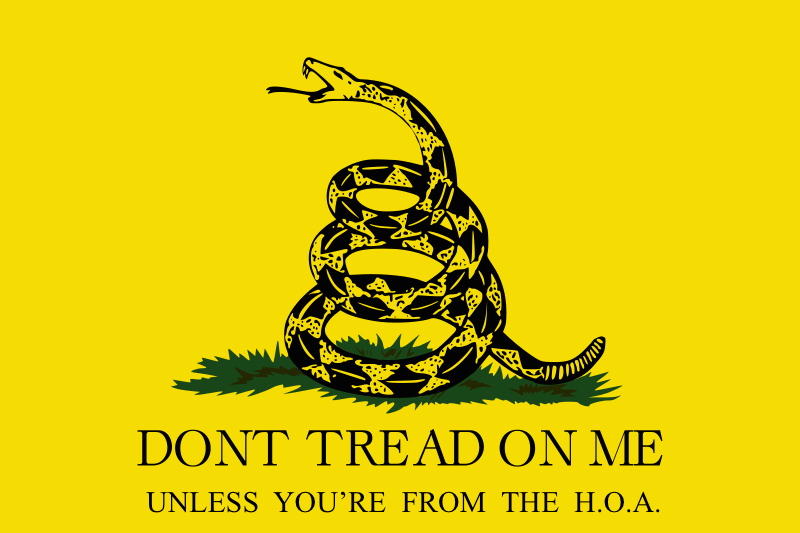
I will never join a HOA because I am a libertarian and don’t want a group telling me what I can or can’t do with my property.
**SUBMISSION STATEMENT**
https://preview.redd.it/5eq35wnexete1.png?width=800&format=png&auto=webp&s=bfeef3245a6440b9d863ebd289b62030bf8d4d28
>Over the last three decades, sweeping reforms in American local governance have gone largely unnoticed in the field of public affairs. Homeowners associations (HOAs) now outnumber all local governments by more than three to one, but the implications of this change have yet to be considered. Homeowners associations have been called private governments because they do many things that governments do. HOAs hold elections, provide services, tax residents, and regulate behavior within their jurisdictions, but as legal entities, they are not governments (**p.535**)
>HOAs are organized as nonprofit corporations, governed by elected boards of directors that serve as unpaid volunteers. The boards of larger communities often hire a manager or management firm to handle the HOAs’ operations, creating a structure similar to a council-manager city. As private enterprises, HOAs’ managers and elected decision makers are free of many procedures and practices that apply to government officials, and within HOA jurisdictions, individuals are not necessarily guaranteed the rights that governments are compelled to protect (**p. 536**).
>As policy makers, HOA boards can pass additional restrictions that they then enforce. “The board of directors passes the rules, prosecutes the alleged violators, and adjudges ‘guilt,’”. Boards can impose fines and other sanctions on rule breakers (**p. 536**).
>As private entities, HOAs’ internal procedures and powers more closely resemble corporations than governments. HOAs may not be subject to state “sunshine” laws, which require public notice, open meetings, and open records when officials gather to make policy decisions, and they need not follow public budgeting, procurement, or hiring practices. HOAs’ private status also allows the CC&R to be more restrictive than even the most stringent local land-use laws. HOA rules may be so precise as to specify where you may wear flip-flop sandals or whether you may use your back door as the entrance to your house (**p. 536**).
>To raise revenue for goods and services, HOAs lack taxing authority but not the power to charge assessments, which makes their inability to tax more a legal distinction than a real constraint. HOAs’ enforcement powers for failure to pay assessments equal those of local governments and allow them to place liens or foreclose on property, a power that the courts have upheld repeatedly (**p. 537**).
>- Barbara Coyle McCabe. “[Homeowner Associations As Private Governments](https://web.archive.org/web/20170809074411/http://illinois-online.org/krassa/ps410/Readings/HOAs/McCabe%20HOA%20as%20Private%20Government.pdf)”. *Public Administration Review*. 71:535-542. July/August 2011.
.
>And in 33 states, an HOA does not need to go before a judge to collect on the liens.
>It’s called nonjudicial foreclosure, and in practice it means a house can be sold on the courthouse steps with no judge or arbitrator involved. In Texas the process period is a mere 27 days – the shortest of any state.
>With the recession, foreclosure filings for delinquent HOA assessments in Texas have increased from about 1 percent of all home foreclosures to more than 10 percent currently, according to the industry.
>- National Public Radio. “[Not So Neighborly Associations Foreclosing On Homes](https://www.npr.org/2010/06/29/128078864/not-so-neighborly-associations-foreclosing-on-homes)”. *All Things Considered*. July 29, 2010.
Id like you to walk me through your thought process on this one
How so?
Local governments love HOAs, because it’s easy to deal with them than with real live people. Many HOAs are created because otherwise local governments will not even issue developers a build permit unless there’s an HOA. How many times have you seen people on non-HOA street just go and spontaneously create one?
I will start by saying I HATE HOA’s, but in theory at least in size and scope they would be the most libertarian government. Small footprint, non-violent enforcement, to get to something more to your preference you need to move relatively small distances. But I am not a fan of telling people what you can do with your own property.
If I want to grow ficuses I damn well will.
No, they’re the least libertarian because the few people who serve in them can enforce “by-laws” capriciously with no accountability or oversight, and no appeal process. They’re actually an ADDITIONAL layer of bureaucracy in addition to “regular” government over what you can and can’t do with your own property.
If HOAs are libertarian then I’m Mickey Mouse