
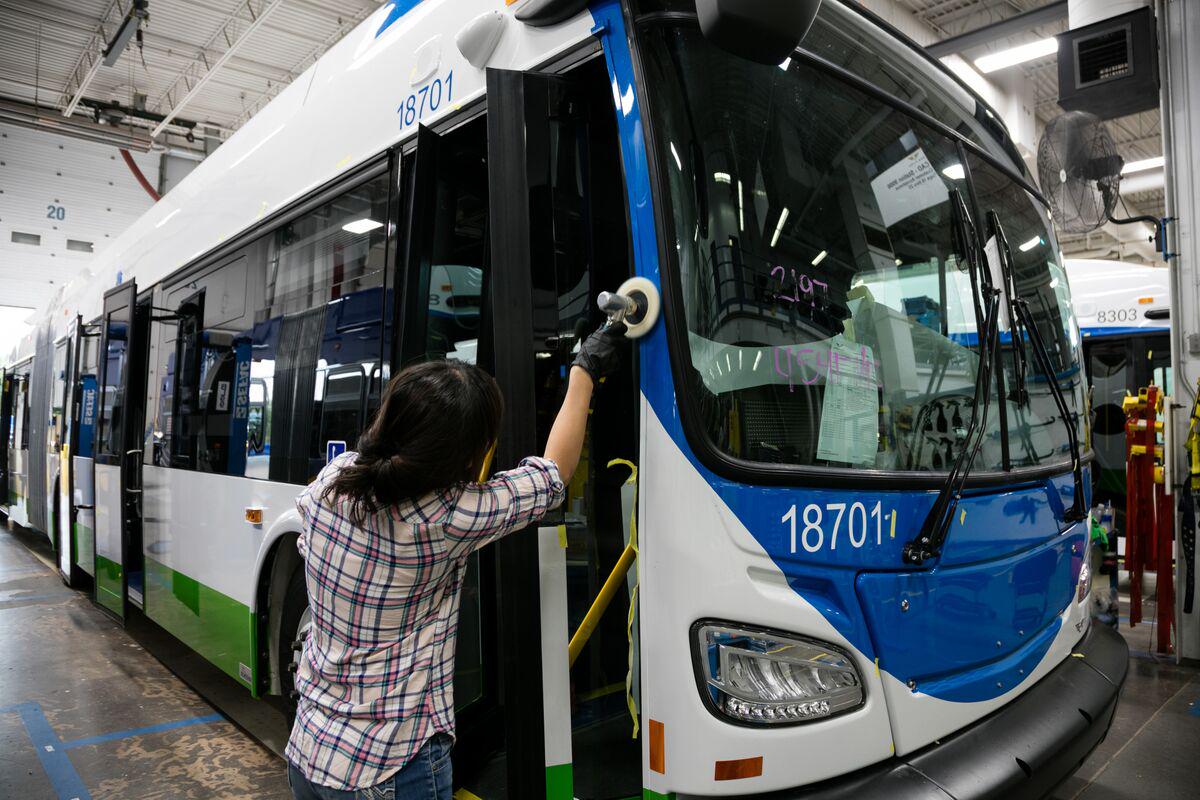
Why US cities pay too much for transit buses | A new paper argues that lack of competition, demand for custom features and “Buy America” rules have driven up costs for transit agencies in the US
Posted by ONETRILLIONAMERICANS
Why US cities pay too much for transit buses | A new paper argues that lack of competition, demand for custom features and “Buy America” rules have driven up costs for transit agencies in the US
Posted by ONETRILLIONAMERICANS
2 Comments
new Ed Glaeser paper:
> # Overview of the problem
> After analyzing the data, the researchers reached several conclusions. First, average prices for diesel, hybrid and electric buses have been remarkably consistent for many years, a stability that is especially striking for electric buses given the rapid evolution in battery technology. Second, individual procurement costs are wildly divergent; one agency may spend twice as much as another for essentially identical vehicles.
> Third, even “cheap” US buses are still more expensive than those purchased in Europe or Asia. Singapore’s recent bus order, for example, went to BYD Co., the Chinese electric vehicle giant; Hyundai, a Korean manufacturer, offers electric buses to agencies overseas for $350,000, less than a third the average price paid by American transit systems.
> Since buses are bought with public funds, inflated costs indicate an inefficient use of taxpayer dollars. Worse, they could undermine transit service by delaying the replacement of older, breakdown-prone models. Transit agencies are also forced to issue more debt to cover their 20% federal match, limiting money available to solidify operating budgets that have become dangerously shaky due to escalating costs and ridership that remains below pre-Covid levels.
> # Duopoly
> Part of the problem, the coauthors argue, is that the US bus market is now a duopoly dominated by two manufacturers: California-based Gillig Corp. and New Flyer Industries Ltd., a Canadian firm, neither of which responded to requests for comment. (BYD established a bus plant in California in 2014, but its production has been hamstrung by Federal Transit Administration rules that prohibit using federal dollars to purchase buses made by Chinese companies.) A lack of vendor options hampers transit agencies’ ability to negotiate when making a deal. A similar challenge faces US fire departments, which can only procure new ladder trucks and pumpers from a dwindling number of manufacturers.
> The paucity of bus manufacturers is a relatively recent phenomenon. In 2023, Proterra Inc., a California electric bus maker, declared bankruptcy, while Nova Bus, a unit of Volvo, announced that it would exit the US market. In subsequent research, the Eno Foundation found that both companies’ struggles arose in part from transit agencies requesting customizations that complicated production processes and increased costs.
> # Excessive cosmetic customization
> In a large country like the US, some variation in bus design is inevitable due to differences in conditions like weather and topography. But Silverberg said that many customizations are cosmetic, reflecting agency preferences or color schemes but not affecting vehicle performance.
> “I’ve heard one of the big vendors say that they have to keep in stock dozens of shades of gray paneling, because every agency wants a different one for their bus,” Silverberg said. She noted that Gerflor, a bus flooring provider, recently sent an email to attendees of a large transit conference pitching its “ability to provide your agency with a truly distinctive floor,” and promising transit officials that “you have complete control over colors and design.” Such individualization is likely to inflate costs. (Gerflor did not respond to a request for comment.)
> Silverberg and her coauthors found that fully 70% of US bus procurements in 2024 were unique, meaning that there was no identical procurement anywhere in the country. (Customization seems to be increasing: 20 years ago, “just” 45% of bus procurements were unique.) With a median contract size of just five vehicles, bus operators cannot exploit economies of scale to lower production costs.
> # “Buy American” rules
> The final contributor to high bus prices, the coauthors found, are “Buy America” rules that prevent federal funds from being spent on products manufactured in other countries. That requirement has effectively blocked US transit agencies from capitalizing on the lower prices offered by bus manufacturers in other countries.
> The problem is not limited to buses: Eric Goldwyn, an assistant professor at New York University’s Marron Institute of Urban Management who leads the Transit Costs Project, said in an email that Buy America rules also inflate the costs of transit rail cars. (Goldwyn was not involved in the study.)
!ping TRANSIT&YIMBY
American Transit Agencies:
“Look at our gorgeous branding, vehicles, and transit centers. For the low cost of $1 Billion Dollars we’re able to run 10 buses a day from Santa Monica to DLTA.”