
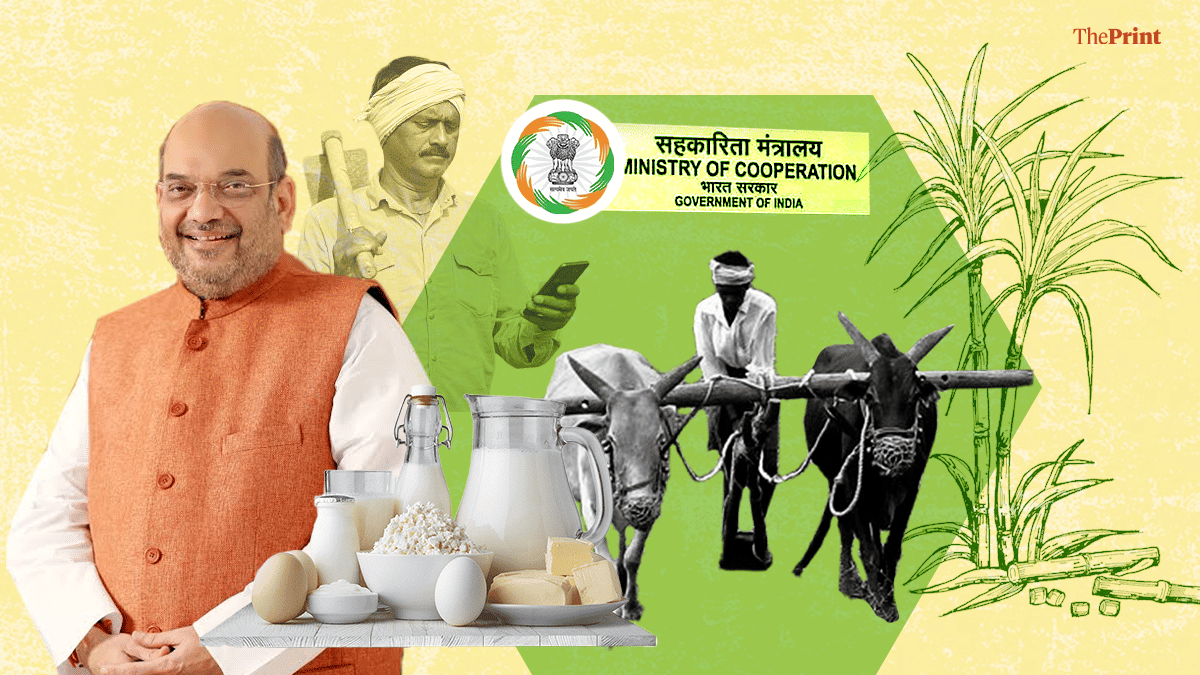
India's coop sector is undergoing a bunch of changes, taking it from somewhat of a backwater part of the ministry of agriculture into a fully fledged department. There is new measures such as a new cooperative university and a co-op taxi. Improvement to urban coop banks.
Posted by ewatta200
2 Comments
**New Delhi:** For decades, India’s cooperative movement occupied an unusual position in the country’s economic landscape, touching millions of lives through dairy, rural credit, fertiliser distribution and sugar production, yet rarely finding a place at the centre of policymaking.[](https://theprint.in/sport/harjinder-wins-silver-as-india-bag-seventh-weightlifting-medal/2999538/?utm_campaign=theprint&utm_medium=ticker&utm_source=vdoai_ticker)
The subject remained a department under the Ministry of Agriculture, competing for attention with agriculture, food security and farmers’ welfare.
However, the cooperatives sector today has moved beyond dairy and agriculture, expanding its footprints to newer areas like ride hailing taxis, insurance, renewable energy among others.
It was in July 2021, during the second term of Prime Minister Narendra Modi led NDA government, that a separate Ministry of Cooperation was created and Union Home Minister Amit Shah, one of the Bharatiya Janata Party’s (BJP) most influential leaders with long experience in Gujarat’s cooperative movement, was given its charge.
For many associated with the sector, that single decision marked the beginning of its biggest institutional shift in decades.
“I would not say cooperatives were neglected, but they certainly did not receive the attention they deserved,” says Prabhat Chaturvedi, Chief Executive Officer of the National Urban Cooperative Finance and Development Corporation (NUCFDC). “The creation of a separate ministry brought renewed focus. Because it is headed by one of the most influential ministers in the Cabinet, other ministries also started taking the cooperative sector much more seriously.”
Laxmi Dass, the President of the National Federation of Urban Cooperative Banks and Credit Societies (NAFCUB), echoes that view. Having spent over three decades in the cooperative sector, he says stakeholders had long sought a separate ministry.
“Whenever a full-fledged ministry is created, it naturally gives greater thrust to that subject. Earlier, cooperation kept shifting between ministries. Today, there is a dedicated ministry with a minister who himself understands the cooperative movement,” Dass told ThePrint.
Five years later, that political attention has translated into much more: a new cooperative policy after more than two decades, digitisation of thousands of Primary Agricultural Credit Societies (PACS), an attempted turnaround of urban cooperative banks, creation of a national cooperative institutions for exports, organic farming and quality seeds, and cooperatives pushed into sectors ranging from ride-hailing and insurance to renewable energy.
Supporters credit the ministry with giving the sector unprecedented political backing, while experts argue the next phase must focus on stronger governance, professional management and financially sustainable institutions.
On 6 July, Cooperation Minister Amit Shah lays foundation stone of various developmental schemes on occasion of ‘Golden 5 Years’ completion of the Ministry of Cooperation. | ANI
If there was any visual reminder of how much the sector’s standing has changed, it came earlier this month, on 6 July at New Delhi’s Bharat Mandapam. Nearly 14,000 representatives of cooperative societies – from dairy unions and credit societies to urban cooperative banks and farmers’ organisations – filled the convention centre as Shah addressed the Ministry of Cooperation’s fifth Foundation Day celebrations.
Calling the last five years “a golden period” for the cooperative movement, Shah said, “In these five years, we have identified problems, nurtured possibilities and also provided future-oriented policies to States.”
# From a department to centre of policymaking
The significance of creating the Ministry of Cooperation becomes clearer when viewed against the sector’s institutional history. According to Shah, cooperation remained under the agriculture ministry for nearly six decades and was handled largely at the level of a joint secretary.
“Today, a fully independent Ministry of Cooperation is moving forward by taking all states and 8.30 lakh cooperative societies across the country along,” he said during the 5th Foundation Day celebrations.
Beyond symbolism, stakeholders say the ministry has fundamentally changed how the sector interacts with the government. Earlier, cooperative institutions often struggled to get policy attention because the department functioned alongside agriculture and farmers’ welfare.
Today, sector representatives say ministries ranging from MSME to food processing are engaging more actively with cooperatives, particularly in banking and credit delivery.
The numbers underline the scale of the sector. According to the Ministry of Cooperation, India today has more than 8.5 lakh registered cooperative societies, of which around 6.6 lakh are functional, operating across nearly 30 sectors and serving 32 crore members.
Three decades ago, the movement had around 22 crore members and remained concentrated largely in agriculture and rural credit.
# New policy for a changing economy
Perhaps the ministry’s most significant long-term intervention has been the National Cooperative Policy 2025, the first comprehensive overhaul of India’s cooperative policy framework in more than two decades.
The previous policy, framed in 2002 by Atal Bihari Vajpayee’s National Democratic Alliance (NDA) government, has outlived its utility given India’s digital transformation, the rapid growth of e-commerce and the changing structure of the rural economy.
Recognising that the cooperative movement had to evolve, the Ministry of Cooperation in 2022 appointed a 48-member committee headed by former Union minister Suresh Prabhu to draft a new roadmap.
Following consultations through regional workshops, stakeholder meetings and hundreds of suggestions, the policy was unveiled in August 2025.
The new policy looks beyond strengthening existing cooperatives, seeking to redefine where the movement should grow over the next decade. The new policy encourages cooperatives to enter sectors where they have traditionally had little presence – renewable energy, waste management, healthcare, education, organic farming, ethanol and biogas production, besides aggregator platforms for taxi drivers and other service providers.
It also places strong emphasis on digital governance, transparency and professional management across cooperative institutions. The policy aims to expand the cooperative sector’s contribution to the economy, promote cooperative societies in every village and encourage greater participation of women and young professionals.
It also noted a need for closer coordination between the Centre and States to ensure more uniform implementation of cooperative reforms.
I wonder if cooperatives can be the method of compromise between the entrenched farmer groups that hold a lot of political power while allowing for technological reforms.
If so then this model should be studied by the rest of the developing world as a more stable, gradual, and democratic means of developing rural areas.