
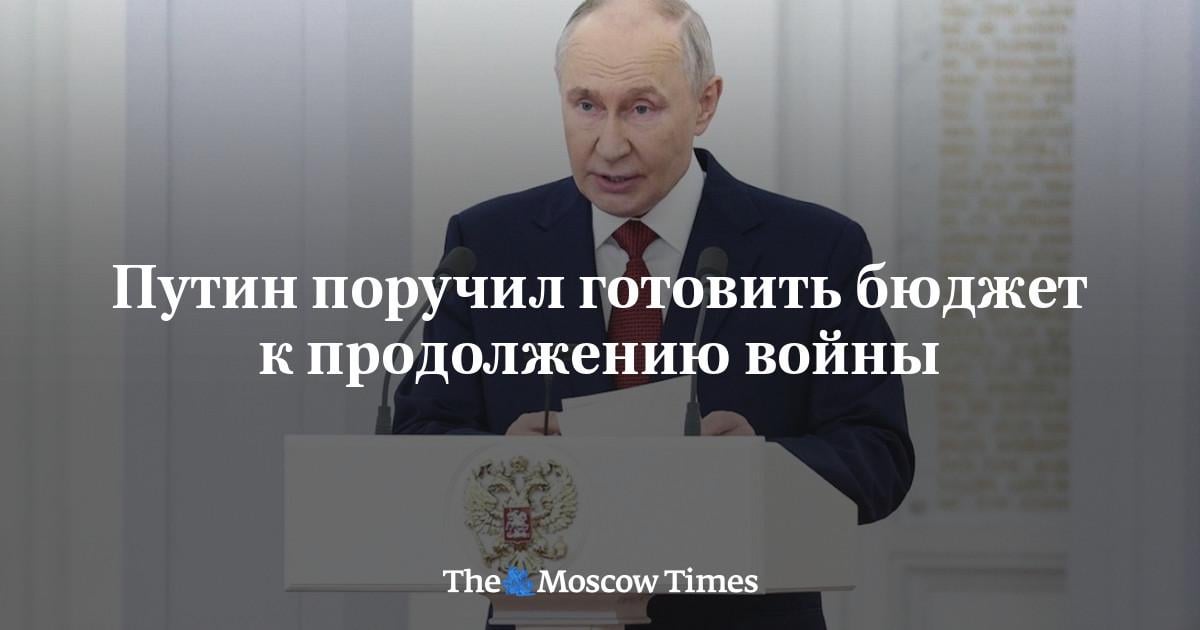
Military spending will remain a priority in the preparation of the budget for the next three years, Russian President Vladimir Putin stated on Monday.
At a meeting with deputies of the 8th State Duma—which concluded its work on July 27—Putin accused the West of launching a "Russophobic machine" and setting "world records" for sanctions, declaring that "no one, ever" would succeed in "breaking the people of Russia."
"Our political system and institutions of power are being shaped on a sovereign basis, in full compliance with the Constitution of the Russian Federation; they are prepared to defend the country and capable, together with society, of delivering a decisive rebuff to any hostile actions," Putin stated. In addition to "strengthening the country's defense," he said, a priority for the 2027–2029 budget must be "addressing key social objectives."
The government had initially allocated 12.9 trillion rubles for "national defense" in the 2026 budget. However, the actual military budget will exceed the planned figure by 4–5 trillion rubles, sources familiar with the situation told Bloomberg in June. According to them, to cover all war-related expenses, the Finance Ministry is preparing to cut civilian spending and intends to raise an additional 2–3 trillion rubles in debt.
Actual budget spending on the war with Ukraine reached 5.9 trillion rubles in the first quarter alone, according to calculations by Janis Kluge, a researcher at the German Institute for International and Security Affairs, based on Finance Ministry data. Compared to the same period last year, spending on the military and weapons production rose by 29.9%; compared to January–March 2024, it increased by 68.7%; compared to 2023, by 129%; and compared to the first quarter of 2022, it grew 4.6-fold.
By his calculations, the cumulative cost of the war with Ukraine since 2022 has amounted to 53.079 trillion rubles—or $746.6 billion—for Russian taxpayers. This sum covers 28 years of current budget spending on healthcare, 30 years of spending on education, and the equivalent of 100 annual budgets for major regions such as Krasnoyarsk Krai or Sverdlovsk Oblast.
The priority given to defense and security in the budget compels the authorities to take a "more selective approach" to funding other areas, observes Emil Ablaev, a leading expert at the Center for Macroeconomic Analysis and Short-Term Forecasting (CMASF). At the same time, the scope for boosting budget revenues through continuous tax hikes is diminishing, he notes.
Last year, despite increases in the corporate profit tax and the vehicle disposal levy, budget revenues fell 3 trillion rubles short of the target; this year, the problems have "intensified," notes Ablaev: the Finance Ministry raised the VAT to 22%, yet the deficit reached nearly 6 trillion rubles in the first half of the year alone. By year-end, the "hole" in the treasury could widen to 7 trillion rubles, the expert predicts.
Translated by Google Translate, mistakes are my own.
Posted by IHateTrains123