
Damage to Russian refineries still visible from space months after strikes
President Vladimir Putin travelled to a refinery in the Black Sea port of Tuapse in 2013 to launch what was then Russia’s most powerful oil-processing unit. He declared the sophisticated technology “extraordinary”.
Thirteen years later, the facility stands as a symbol of a different technological advance: Ukraine’s ability to strike with precision deep into Russia and inflict lasting damage on its energy infrastructure.
The refinery is among the worst-hit in Ukraine’s recent wave of audacious long-range drone strikes, which have aimed to hobble production by targeting and destroying critical components.
An FT analysis of refinery layouts, photographs, satellite images and thermal-infrared data shows that damage at several major Russian refineries has persisted for weeks or even months after attacks. Additional analysis was provided by Frontelligence Insight, an analytical group operated by a former Ukrainian officer.
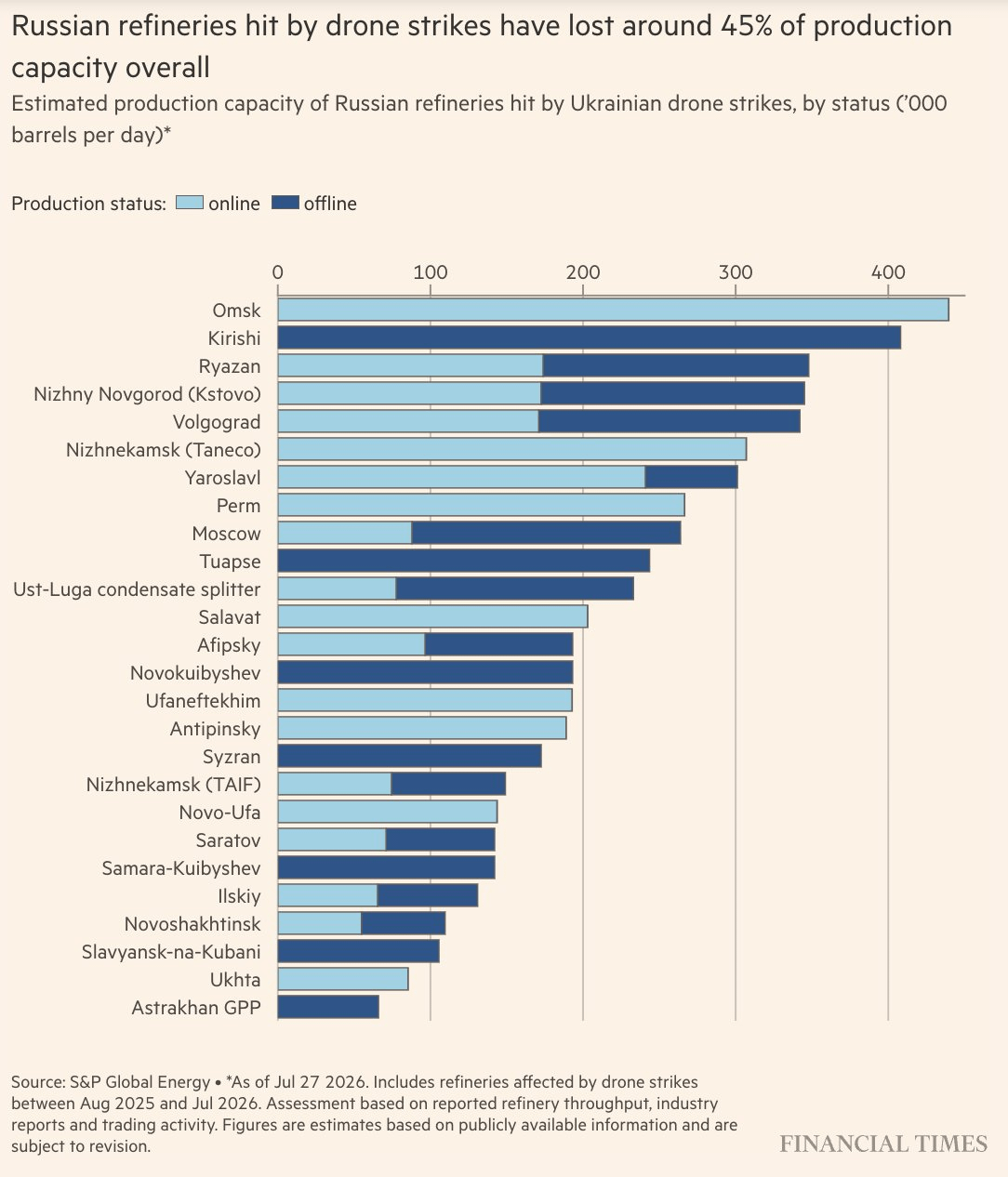
The Ukrainian campaign knocked out more than 30 and 45 per cent of Russia’s actual and nominal capacity, respectively, triggering the worst fuel crisis in the petrostate since the collapse of the Soviet Union.
Strike teams are now being briefed by engineers on which parts of Soviet-designed refinery systems are indispensable, hardest to replace and most likely to keep a plant offline.
In late April, Tuapse was hit by two attacks that sent apocalyptic towers of black smoke into the sky, later falling as toxic rain.
The strikes wiped out more than a dozen large and medium-sized reservoirs with approximately 80,000 cubic metres of storage capacity, the FT estimate shows.
More significantly, the drones also appear to have destroyed a secondary processing unit built as part of a modernisation programme hailed by Putin. The refinery is so old that it features in now-declassified CIA surveillance footage from the 1950s.
Such units break down heavy, low-value oil into lighter products, such as diesel, jet fuel and gasoline, said Sergey Vakulenko, a senior fellow at the Carnegie Russia Eurasia Center. The refinery could continue operating without it if the rest of the plant remains intact, but the quality of its output would deteriorate significantly.
Other hard-to-replace units include equipment that removes salt and water from crude oil before refining. One such unit was recently hit in Omsk, one of the world’s largest refineries, 2,500km from the Ukrainian border.
These units were critical because they sit at the start of the refining process, said Isaac Levi, an energy policy analyst at the Centre for Research on Energy and Clean Air, a Finnish research group. If damaged, a refinery may lose much of its ability to process crude even if other equipment remains intact. Russian brokerage Finam estimated that repairs usually take up to several months.
Sumit Ritolia, a senior modelling manager at analytics company Kpler, said damage to these types of units typically caused much longer outages than strikes on storage tanks, which can produce spectacular fires but are often quicker to repair.
Most signs of the attacks at Russia’s top 10 largest refineries, including in Omsk, Moscow and Tuapse, remained visible from space weeks or even months after the last known attack, the FT analysis showed.
Satellite imagery shows how slowly repairs are proceeding. More than a month after attacks sent a huge plume of smoke above Moscow, the white lid of a large oil storage tank still lies mangled where it fell. Three smaller tanks, a pumping station and the pipes connecting them to the rest of the refinery also appear visibly damaged.
Smaller refineries also remain largely inoperative, with storage and refining facilities visibly in ruins.
Even after refineries come back online, activity recovers slowly, according to Fabio Sabatini, a researcher at Sapienza University of Rome.
His team measured night-time radiance around 29 large Russian refineries between June 2022 and May 2026. They found that after a first strike, radiance fell by 30 per cent within 1km of the refinery and by up to 18 per cent within 5km. The decline lasted for more than 13 months for the facilities struck last year.
Strikes on military sites, transport nodes or fuel depots did not produce a comparable effect, Sabatini told the FT.
Kstovo, a refinery in Nizhny Novgorod, was struck by drones on May 18 and 20. It has remained offline since, according to thermal-infrared satellite imagery from Constellr, a German intelligence company. In the latest available shot, taken on July 18, its distillation unit still showed no heat signature.
Ukraine’s targeted campaign, aided by US and French intelligence, has helped trigger a severe fuel crisis in Russia, with sales restrictions in nearly every region and long queues at filling stations.
Russia had restored some refining capacity, helped by a resumption of operations at Omsk, said Daniel Evans, global head of fuels and refining at S&P Global Energy. But much capacity remains offline, making supply to Russia’s otherwise balanced domestic market “very challenging”, he added.
Satellite images show Russian refineries have expanded drone defences since 2022. But Ukraine’s repeated drone waves can overwhelm those defences.
A Russian businessman said the strategy, which he compared with medieval cavalry advancing in a wedge formation, had inflicted significant pain on refinery owners.
“The protective methods were effective last year,” the businessman said. But while nets can catch one drone, “when three hit the same point, it is physically impossible” to stop them.
Posted by IHateTrains123