
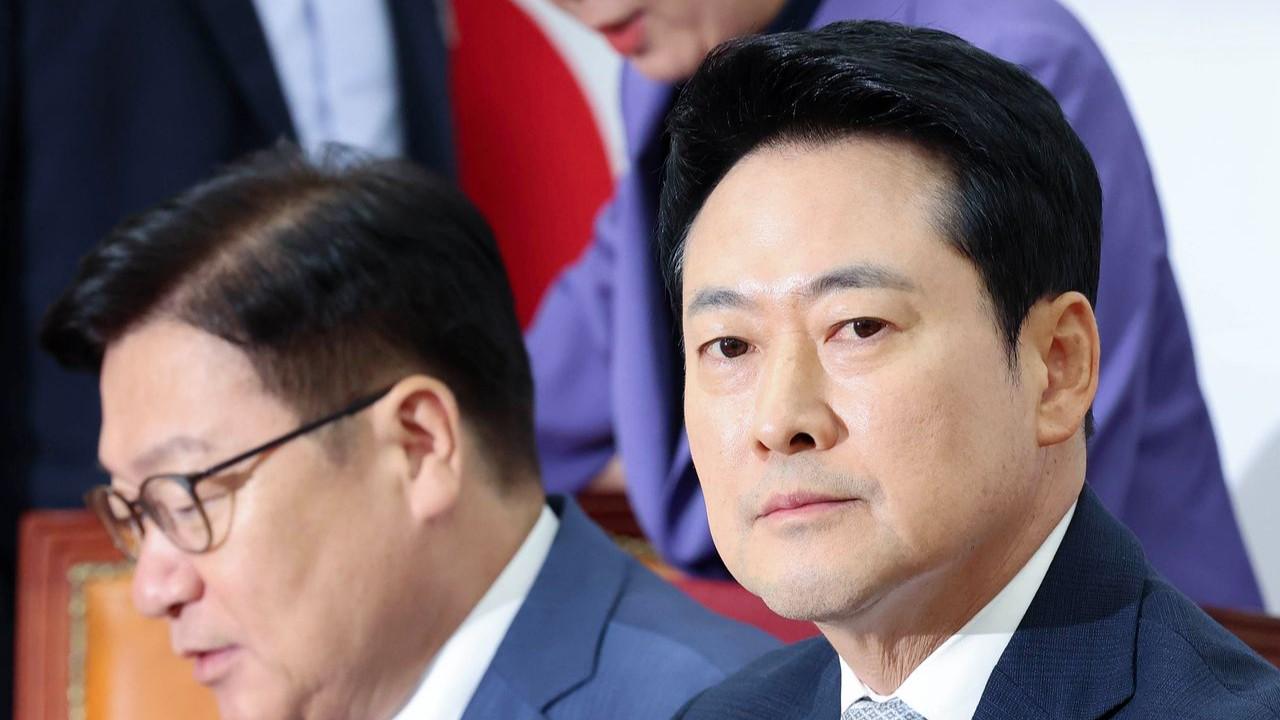
People Power Party leader Jang Dong-hyeok lashed out at the government and ruling party on the 19th, saying, “Go ahead and impeach the chief justice. The public will impeach the administration.”
In a Facebook post that day, Jang wrote, “The Blue House and the Democratic Party of Korea are having a fit because Chief Justice Cho Hee-dae recommended a Supreme Court justice,” comparing President Lee Jae-myung and the Democratic Party to “a bully president and a delinquent group.”
Floor leader Jeong Jeom-sik also criticized the Democratic Party in a Facebook post the same day, saying, “If breaking convention is grounds for impeaching Chief Justice Cho, then every Democratic Party lawmaker should be subject to impeachment.”
The remarks came after the Democratic Party raised the possibility of impeaching Cho over his written recommendation of a Supreme Court justice nominee. The People Power Party’s two top leaders responded in unison by effectively threatening impeachment in return.
In this way, the People Power Party has been going all-in on aggressive messaging whenever political troubles emerge for the ruling camp.
When reports surfaced on the 17th that U.S. President Donald Trump had ordered a reduction in South Korea-U.S. joint military exercises, party figures criticized the move as “submissive self-harm to national security” (Na Kyung-won) and said it was “undermining the cohesion of the South Korea-U.S. alliance” (Sung Il-jong).
The party also fired back at the government’s push to develop housing in Seoul’s Yongsan Park. On the 19th, Jeong said, “The substandard Democratic Party is in no position to discuss Seoul’s future,” while Seoul Mayor Oh Se-hoon argued, “They are trying to cover up their failure to rein in housing prices with Yongsan Park.”
However, despite a series of setbacks for the ruling camp in sensitive areas such as real estate and national security—and despite the People Power Party mounting daily messaging offensives around those issues—public opinion appears reluctant to rally behind the opposition.
According to Gallup Korea’s mobile-phone interview survey conducted from the 11th to the 13th, support for the People Power Party stood at 25%, compared with 41% for the Democratic Party of Korea. In the National Barometer Survey (NBS), conducted through mobile-phone interviews from the 10th to the 12th, the People Power Party recorded 23% support while the Democratic Party stood at 40%, a gap of 17 percentage points and well outside the margin of error.
What widened the gap was the lack of support from conservative voters themselves. Among respondents who identified as conservative, only 57% in the Gallup survey and 52% in the NBS said they supported the People Power Party. In other words, roughly 40% of conservatives were not backing the party. This contrasted sharply with progressive respondents: 73% in the Gallup survey and 80% in the NBS said they supported the Democratic Party.
Experts say the fundamental problem is that “the People Power Party has become consumed with slogan-like criticism and has failed to present a policy vision or viable alternatives.”
Lee Jae-mook, a professor at Hankuk University of Foreign Studies, said, “Even when the ruling camp suffers setbacks, the People Power Party needs to establish itself in the public mind as a credible alternative. But because it has continued with little more than attacks and messaging offensives, fatigue has grown not only among centrist voters but even among conservatives.”
Lee Hyun-woo, a professor at Sogang University, said, “Take the issue of housing development in Yongsan Park, for example. What stands out is only the People Power Party’s opposition and ridicule, while no alternative proposal is visible at all.”
He added, “Instead of offering alternatives, the party simply repeats provocative slogans such as ‘election fraud’ and ‘nullify the election’ over and over again.”
Posted by Freewhale98