
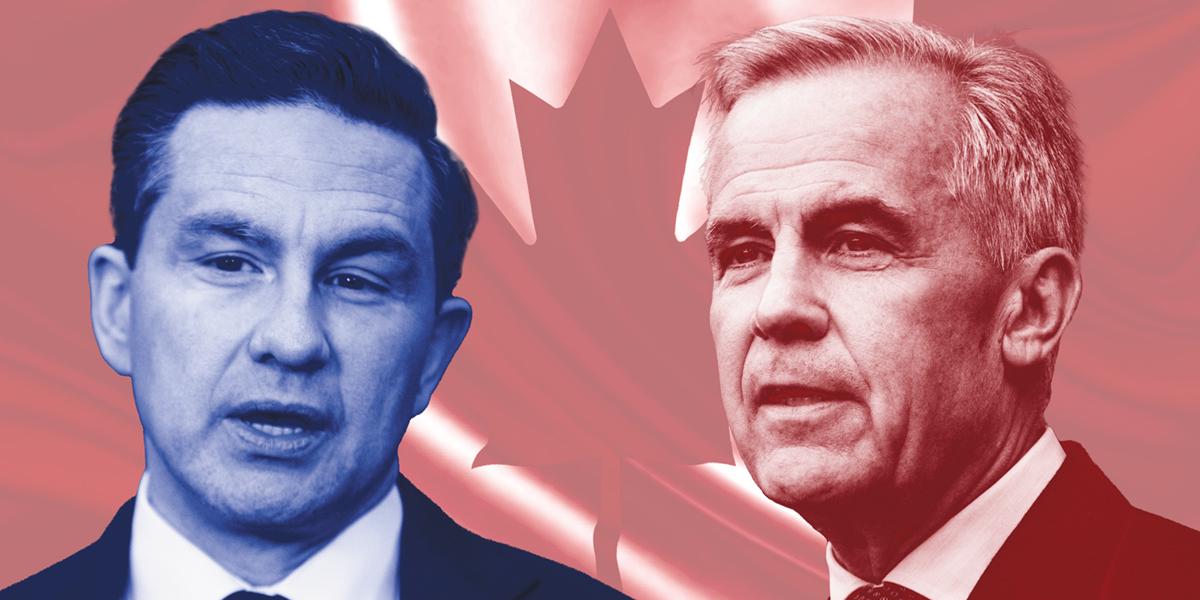
As older Canadians rally behind Prime Minister Mark Carney’s economic ‘safe harbour,’ younger generations remain split, exposing what pollsters say may be the new defining electoral fault line.
Despite a softening of support, the Liberal government maintains a healthy lead over the opposition Conservatives heading into the second half of the summer recess. But with much of that lead attributable to a significant shift in older voters seeking long-term stability, and a closer split amongst the younger cohorts seeking immediacy and disruption, pollsters say the growing generational divide is becoming one of the most important issues in Canadian politics.
Abacus Data CEO David Coletto told The Hill Times that much of the Liberal government’s national polling lead is created by the shift in support among voters aged 60 and older. At the same time, the Liberals are near-evenly matched with the Conservatives among younger cohorts.
Coletto noted that the Liberals held a 20-point lead over the Conservatives amongst those aged 60 and older, 52 per cent and 32 per cent, respectively, but that lead fell to just one point amongst voters aged 45-59—with the Liberals at 40 per cent, the Conservatives at 39 per cent, and the NDP rising from five per cent among the 60-plus group to seven per cent.
According to Abacus Data’s latest national survey published July 19, the two leading parties are also statistically neck-and-neck amongst the two younger demographics, with the Conservatives holding a two-point lead amongst those aged 30-44, with 40 per cent compared to the Liberals’ 38 per cent, as the NDP rises to 12 per cent. Amongst those aged 18-29, the Liberals regain a one-point lead, with 38 per cent of support, followed by the Conservatives at 37 per cent and the NDP at 15 per cent, their highest level of support amongst the four age cohorts.
Coletto said that, unlike previous election cycles when the Conservatives have received stronger support amongst older voters who view the party as the more stable option, that same cohort of voters is now looking to Prime Minister Mark Carney (Nepean, Ont.) as their economic “safe harbour.”
“Older voters, the ‘boomers,’ are looking for a government that will protect the value of their home and ensure that their pensions or savings are protected, “ Coletto explained. “Carney easily won that question among them during the election, and up until today.”
Coletto also noted that while the popularity of Carney’s government can also be attributed largely to his personal favourability, with a net positive impression of +19 compared to Conservative Leader Pierre Poilievre’s (Battle River–Crowfoot, Alta.) -7, the prime minister’s favourability amongst those over 60 is nearly double at +34.
Pollster Nik Nanos, chief data scientist of Nanos Research, told The Hill Times that he believes the generational split will increasingly become a more-contentious political division than the traditional left-right divide.
While the Liberals maintain an 11-point lead over the Conservatives nationally in Nanos’ latest tracking, that lead increases to 37 points among voters over the age of 60, with the Liberals receiving nearly 60 per cent support among that cohort. The Liberals also maintain 14-point leads among the 50-59 and 40-49 age groups, but the Conservatives lead with 30- to 39-year-olds by seven points, with the Liberals in a tie with the NDP at 28, and a 15-point lead amongst voters aged 18-29.
“The battle brewing in Canada is generational, and they are country miles apart,” Nanos said, adding that while he doesn’t see any brewing revolutionary desire among the younger cohorts, they are nonetheless becoming increasingly dissatisfied with Canada’s social contract.
“That contract is fundamentally under strain because young people are working hard but struggling to pay the bills, and the idea of being able to buy a home without help from someone else is a stretch, and as a result, they are impatient and angry,” Nanos explained, noting that those over the age of 60 are “more likely to be satisfied with the state of things, not want change, and not think the country is broken or that the economic disruption is a threat to you.”
“The flip side is that our young people are at the opposite end of the spectrum … they’re dissatisfied and pessimistic about the future,” Nanos said.
Nanos also attributes the divide to differences in generational expectations of what “long term” and “immediate” mean.
“Carney is playing a long-term game. If you’re over 60, you’re facing less immediate pressures from the economy, but if you’re 25 and can’t pay for groceries, a long-term strategy is hard to take when you’re struggling today,” he said.
While Nanos said that Poilievre has a “political edge” with younger voters looking to disrupt or vent their frustration with the system, “even though they’re fired up, it puts the Conservatives at a disadvantage because young people are the least likely to vote.”
Voter turnout increased with age during the 2025 election, going from 55 per cent for ages 18-24 to 77 per cent for ages 65-74, before declining to 69.1 per cent for those aged 75 and older. However, voter participation among the youngest cohort increased compared to the previous election by nine points, up from 46.7 per cent in 2021.
Poilievre can’t ‘out-Carney’ the PM on stability and retain disruptor edge: Coletto
While Coletto said he believes there is still a possibility for the Conservatives to win back older voters, it would require a new context in which Poilievre is viewed as a more stable option like he was during then-prime minister Justin Trudeau’s final two years in office.
However, in the current context, Coletto said the Conservatives may not be able to win over older voters while remaining competitive with younger demographics, who he said are “more inclined to want to see change, to break things, and to disrupt.”
Alongside specific concerns like the cost of living and the economy—which remain the top two priorities for voters in Abacus’ latest polling, at 64 per cent and 37 per cent, respectively—younger voters are becoming increasingly concerned and dissatisfied with Canada’s economic and political systems as a whole, Coletto said.
While the majority of Canadians still approve of democracy (72 per cent) and a free-market economy (51 per cent), Abacus’ recent survey on Canadians’ impressions of various economic and political systems found that younger Canadians are far more receptive to alternatives.
Among Canadians aged 60 and over, 83 per cent have a positive impression of democracy, but that falls to 62 per cent among those aged 18 to 29, with a similar pattern for positive impressions of a free-market economy, falling from 61 per cent for those 60 and over to 39 per cent for those under 30.
Those under 30 also have much more positive impressions of alternative systems across the political spectrum, including democratic socialism (43 per cent), socialism (39 per cent), communism (26 per cent), populism (22 per cent), and authoritarianism (17 per cent).
“There’s no widespread appetite for a socialist revolution in Canada, but there’s an appetite among younger Canadians for a disruptor,” Coletto said, noting both Poilievre and NDP Leader Avi Lewis’ stronger polling among younger voters.
In comparison, Coletto said older voters—particularly homeowners and retirees with pensions—will be far less inclined to feel a system that put them in that position is broken, and are far more concerned with external threats, like international conflicts or the trade war with the United States and President Donald Trump’s continued tariff threats.
While the Conservatives maintain a lead over the Liberals on the cost of living (36 per cent to 30), the economy (41 per cent to 38 per cent), and housing affordability (31 per cent to 29 per cent), the Liberals hold a 48-point lead over the Tories on the question of who Canadians view as best suited to take on Trump, and a nine-point lead on which party can best handle the threat posed by China and Russia (40 to 31 per cent).
Coletto said that the national focus will eventually shift back to more domestic economic issues, which would be to the Conservatives’ benefit, but Poilievre can’t “out-Carney” the prime minister to win back older voters while maintaining his edge with younger generations.
“The Conservatives can’t stay competitive with middle-aged and younger Canadians concerned about the cost of living and their ability to find and keep a job while simultaneously competing to win over the majority of boomers looking for stability,” Coletto explained. “You can’t be for both sides.”
Posted by IHateTrains123
1 Comment
I mean it is pretty simple but difficult, just have conservative firms or companies hire young people without too much difficulty on the employee’s side and then slip in conservative rhetoric and most of them will flip easily