
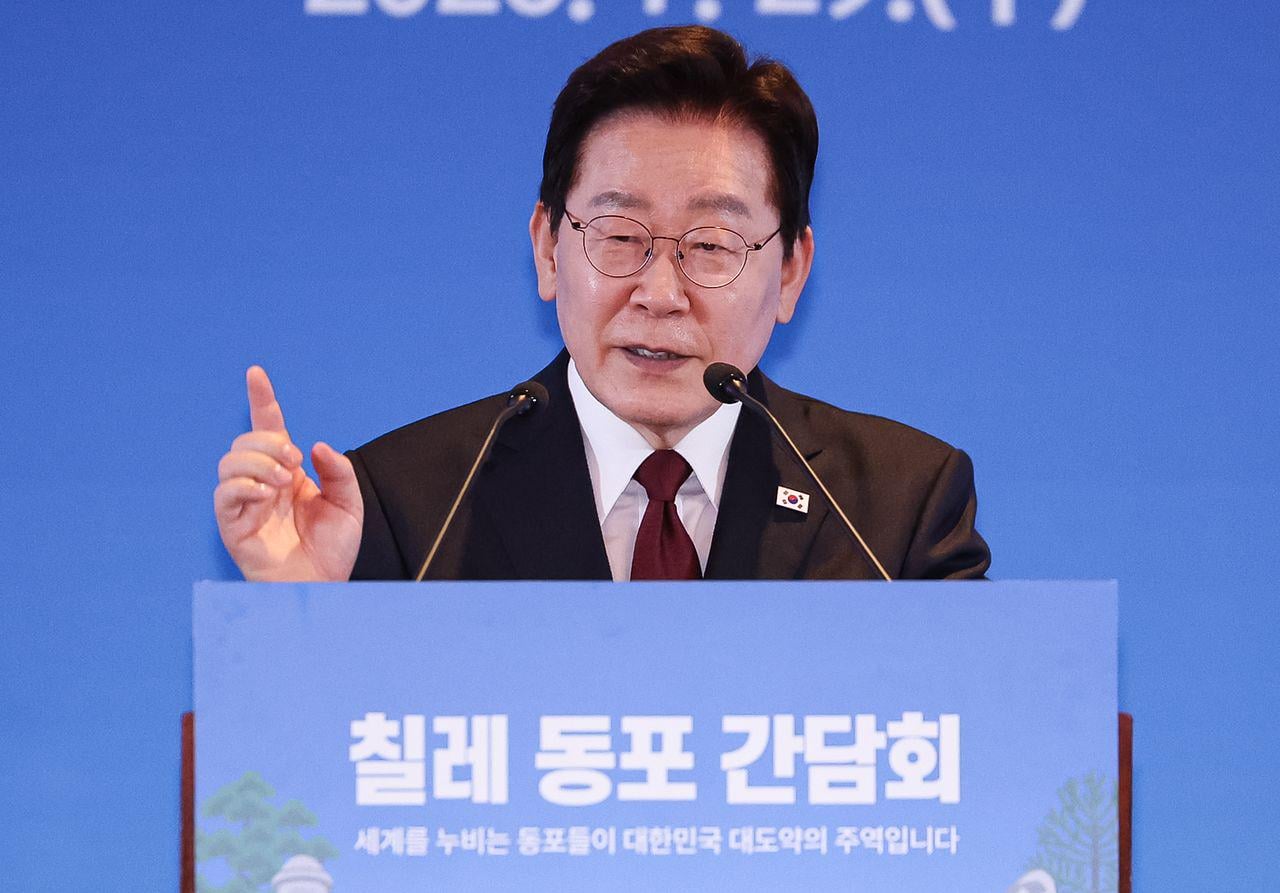
A public opinion poll released on July 30 showed that President Lee Jae-myung’s approval rating for his handling of state affairs stood at 53%.
According to the National Barometer Survey (NBS), conducted by Embrain Public, KSTAT Research, Korea Research, and Hankook Research among 1,000 adults aged 18 and older from July 27 to 29, 53% of respondents positively evaluated President Lee’s performance, down 2 percentage points from 55% in the previous survey.
President Lee’s approval rating had also fallen by 3 percentage points in the preceding survey, marking a decline for two consecutive surveys. The 53% approval rating was the lowest recorded since the second week of June last year, shortly after he took office.
Thirty-seven percent gave a negative assessment, while 10% either said they did not know or did not respond.
Among respondents in their 30s and younger, negative assessments were relatively high compared with positive ones. The approval rating was 41% among those aged 18 to 29 and 50% among those in their 30s. By ideological orientation, positive evaluations were dominant among progressives, at 82%, and moderates, at 53%, while negative evaluations were dominant among conservatives, at 62%.
In terms of party support, the Democratic Party recorded 40%, the People Power Party 21%, the Rebuilding Korea Party and the New Reform Party 2% each, and the Progressive Party 1%. Thirty-three percent withheld support, including those who said they supported no party or did not know.
Compared with the previous survey, support for the Democratic Party rose by 2 percentage points, while support for the People Power Party fell by 1 percentage point.
When respondents were asked who would be the most suitable next leader of the Democratic Party ahead of its national convention on August 17, 21% chose Jung Chung-rae, 19% Kim Min-seok, and 6% Song Young-gil. More than half, or 54%, either chose no one or said they did not know.
Among Democratic Party supporters, Kim Min-seok ranked first with 34%, followed by Jung Chung-rae with 29% and Song Young-gil with 9%.
On the future direction of the benchmark interest rate, 42% said it should be lowered, 29% said it should remain unchanged, and 20% said it should be raised.
Regarding the current government’s housing policy, 33% said it was doing a good job, while 56% said it was doing a poor job. By age group, negative evaluations were higher in every group except those in their 40s and 50s. By region, negative evaluations were higher in every area except Gwangju and Jeolla, and exceeded 60% in the Seoul metropolitan area and in Daegu and North Gyeongsang Province.
Asked about overall housing prices in their current area of residence six months from now, 52% said they expected no change, 31% said prices would rise, and 10% said prices would fall. Expectations of stable prices were dominant in most regions, while in Seoul, 51% expected prices to rise, a relatively higher figure than in other areas.
On mortgage lending regulations, 55% said they should be relaxed, 21% said they should remain at the current level, and 15% said they should be tightened. Overall, there was strong support for easing mortgage regulations, and the tendency was more pronounced among respondents who owned multiple homes.
The survey was conducted through telephone interviews using mobile phone virtual numbers for all respondents. The margin of error was plus or minus 3.1 percentage points at a 95% confidence level, and the response rate was 15.8%. Further details are available on the website of the National Election Survey Deliberation Commission.
Posted by Freewhale98
1 Comment
1. Summary
Democratic Party of Korea is in crisis as presidential approval fall over real estate policy and volatile stock market.
2. How is this related to the sub
(1) Housing crisis: Seoul-centered increase in housing prices and volatile stock market is undermining the popularity of Lee Jae-Myung administration