
The federal government will scale back the water supply for three Southwestern states to manage the growing crisis over the drying Colorado River, officials confirmed Friday.
Officials from the Bureau of Reclamation, which oversees the Colorado River basin — a key source of water for over 40 million people living in the West — said Friday that the federal government will cut more than 1.2 million acre-feet of water supply annually over the next two years. The cuts, which start in 2027, will affect Arizona, California and Nevada — states that contain some of the country’s fastest-growing communities.
Federal officials also said the government would allow the states to “voluntarily conserve” 700,000 acre-feet of water to protect the threatened basin system.
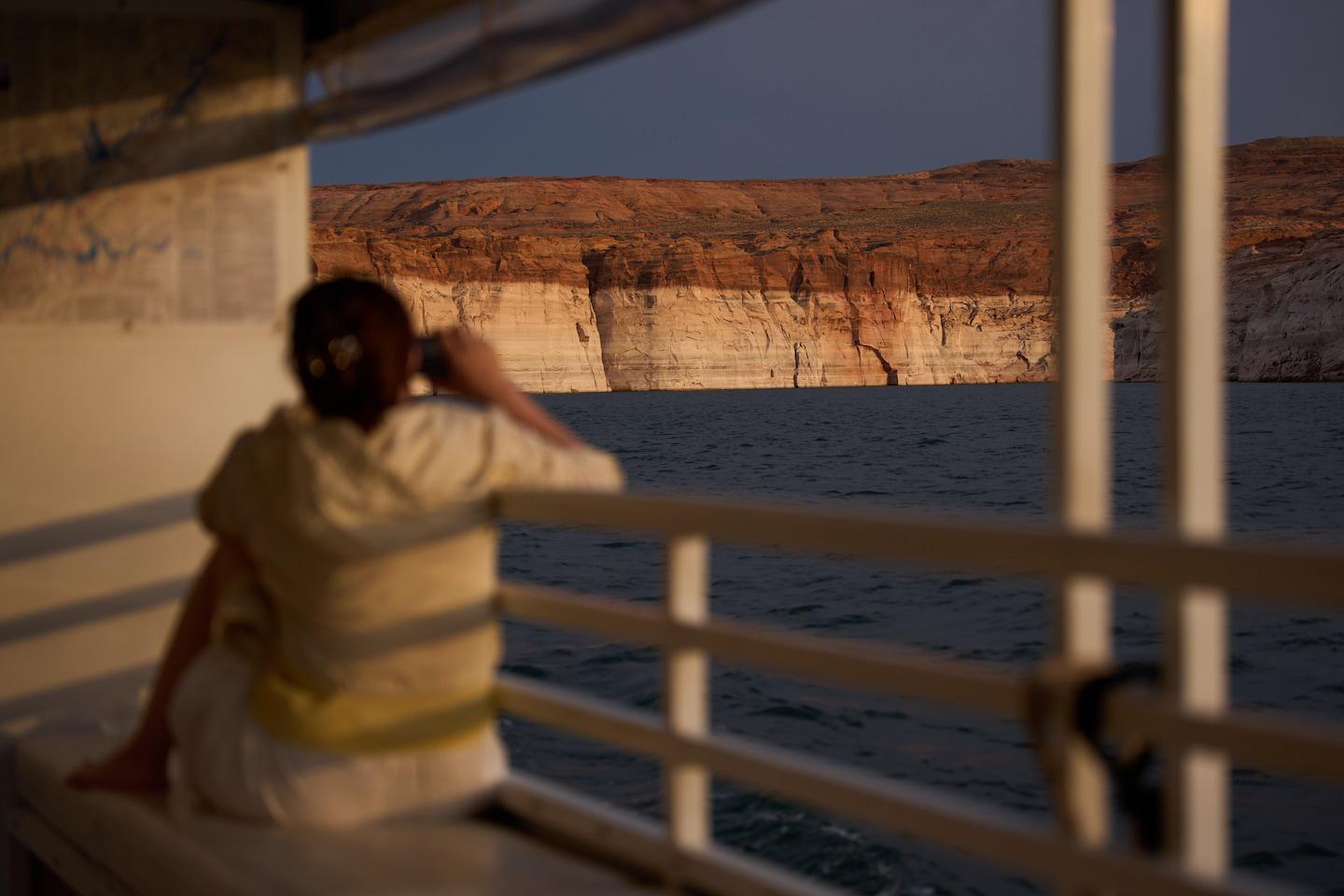
Years of overuse and persistent drought have sent water levels in the river’s two largest reservoirs plummeting to record lows in recent days. Lakes Powell and Mead have not been this low since 1963, when Lake Powell began filling, the bureau said.
The plan, which The Washington Post first reported on last month, could imperil not just water supply but the hydroelectric power relied upon by millions. The government will adjust the water it releases to keep Lake Powell’s level from falling below 3,510 feet, officials said.
“We continue to see a prolonged drought in our future,” said Andrea Travnicek, assistant secretary for water and science at the U.S. Department of Interior. “So continuing to work together as a whole within the basin is going to be extremely important.”
The seven states that receive water from the Colorado River — Colorado, New Mexico, Utah, Wyoming, Arizona, California and Nevada — spent years negotiating a compromise to save the sweeping waterway. The river’s water flow plummeted even further this year after historically low snow levels. The states were unable to reach an agreement by a deadline earlier this year, prompting the federal government to step in. Negotiations between the states are continuing.
The three lower basin states impacted by Friday’s decision have long argued that all seven states must make cuts to preserve the system, and noted that they will be doing their part.
JB Hamby, the chairman of the Colorado River Board of California, called the action a “bridge, not a permanent solution.”
“There is less water in the Colorado River, and the reductions ahead may be greater than anything we have faced before,” Hamby said in a statement. “A durable agreement must spread that responsibility fairly across the basin,” Hamby added, referring to all seven states and Mexico.
The affected states are exploring ways to absorb the cuts, including paying farmers to leave their fields fallow and obtaining water from other sources.
Arizona’s Department of Water Resources said in a statement that the plan “does nothing to elevate expectations around a coherent seven-state plan for shared sacrifice” with no mandatory cuts for upper basin states of Colorado, New Mexico, Utah and Wyoming.
The statement also raised concerns over possible deeper cuts to its water supply over the long term, which the department said would “devastate Arizona’s water users and its economy.”
Posted by John3262005
3 Comments
Very relevant in the US, as it concerns three states but overall seven states are in discussions over a compromise to save the river
It has been less than successful these talks
Guess we will see what the affected states will do to absorb the cuts
Apparently, Arizona is unhappy with no cuts to states like Colorado, New Mexico, Utah and Wyoming.
Genuinely nothing is more stupid than growing shit in the desert
As a Karakalpak-American this really sucks to see