
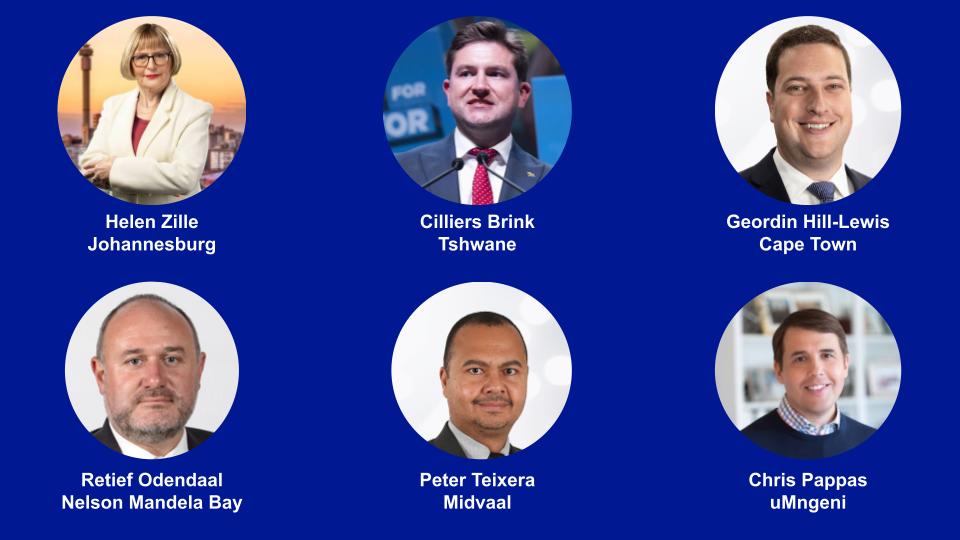
The Democratic Alliance’s 6 Main Mayoral Candidates for the 2026 South African Local Government Elections
Posted by Top_Lime1820
The Democratic Alliance’s 6 Main Mayoral Candidates for the 2026 South African Local Government Elections
Posted by Top_Lime1820
2 Comments
Helen Zille 😍
**Explaine**r
*Background: 2016*
* 10 years ago, the ANC lost its majorities in most of the big cities
* DA mayors took over Johannesburg, Tshwane (Pretoria) and Nelson Mandela Bay (Gqeberha, formerly Port Elizabeth) after the Economic Freedom Fighters (EFF) of Julius Malema refused to work with the ANC
* These DA mayors lasted for two or three years before they ultimately collapsed due to infighting within the party as well as tension with the EFF
*Coalitions of Chaos: 2021 – Present*
* In the 2021 elections, the DA suffered a loss of voters to a major breakaway party, ActionSA, led by their former mayor in Johannesburg
* After the 2021 election, South Africa’s big cities suffered from political instability under a string of chaotic coalitions led by either the DA or the ANC. Neither party could form a stable coalition of serious people. Johannesburg, for example, had 8 mayors in 6 years.
*Midvaal and uMngeni*
* Midvaal is a safe DA municipality in Gauteng province. For a long time (2000 to 2021) it was the only municipality outside of the Western Cape where the DA won majorities.
* uMngeni is the second municipality outside of Western Cape where the DA won a majority (2021). It is located in KwaZulu-Natal province. Unlike the other municipalities on this list, it is not a city but a set of medium sized towns and surrounding rural areas.
* The DA’s candidate in uMngeni, Chris Pappas, created a bit of media buzz because he is a gay White man of Greek ancestry winning in a small town community in a Zulu speaking province. Pappas himself is also able to speak Zulu.
* The Economist: [A white, gay, Zulu-speaking mayor is shaking up South African politics](https://www.economist.com/middle-east-and-africa/2023/01/26/a-white-gay-zulu-speaking-mayor-is-shaking-up-south-african-politics)
* AREtv Documentary on YouTube: [South Africa: A New Mayor](https://www.youtube.com/watch?v=Ev-BbRIdDuE)
*MKP*
* In 2024, former ANC President Jacob Zuma led a new political party to achieve 14% nationally and 45% in KZN province, ending the ANC’s majority in national government and bringing coalition politics to the national parliament.
* 2026 will be the first time his MK party will be on the local ballot. If they replicate their results from the national vote, it will mean that they dominate local government elections in KZN and have an impact in a few other areas.
* The DA beat the ANC in uMngeni in 2021 because in that same year, Jacob Zuma was arrested for contempt of court under an ANC government, leading to an exodus of voters from his party and contributing to massive riots across KZN. Zuma supporters in KZN were furious at the ANC, even as they struggled under lockdowns and the pandemic-era economic decline. The data below give the 2024 national ballot voting results from uMngeni municipality ([IEC data](https://results.elections.org.za/home/NPEPublicReports/1334/National%20Ballot/Results%20Report/KN/KZN222/KZN222.pdf)). This is a good prior for the local government elections this year. This is the council that Chris Pappas could be faced with after the election.
* MKP – 40%
* DA – 39%
* ANC – 13%
* EFF – 1.6%
* IFP – 1.6%
* In Johannesburg, where MKP has some presence, the ANC will likely lose enough voters to MKP such that the DA emerges as the largest party in the city and has the heft to lead coalition negotiations and perhaps form a coalition on its own terms, with Helen Zille as mayor.
*Conclusion*
* Many people overseas still have not updated their model of South African politics.
* The era of the ANC winning all elections and dictating terms is over. It is now true, multiparty coalition politics.
* In the big cities, ANC majorities ended a decade ago. Now we are transitioning to a situation where the ANC may not even be the biggest party in the major cities.
* What happens locally influences what happens nationally in the subsequent elections. If Zille makes a good impression on Johannesburg voters, they may switch their national vote in 2029. Negotiations in local government coalitions influence the factional politics within each party, which again influences subsequent national outcomes. At the end of the day, whether the election is local or national, it is still the same set of voters and politicians trying to gain or keep power.
* If the DA can retake several big cities and form stable coalitions with the ANC, they will be setting themselves up to do well in the general elections in 2029.